Four DC Landmarks
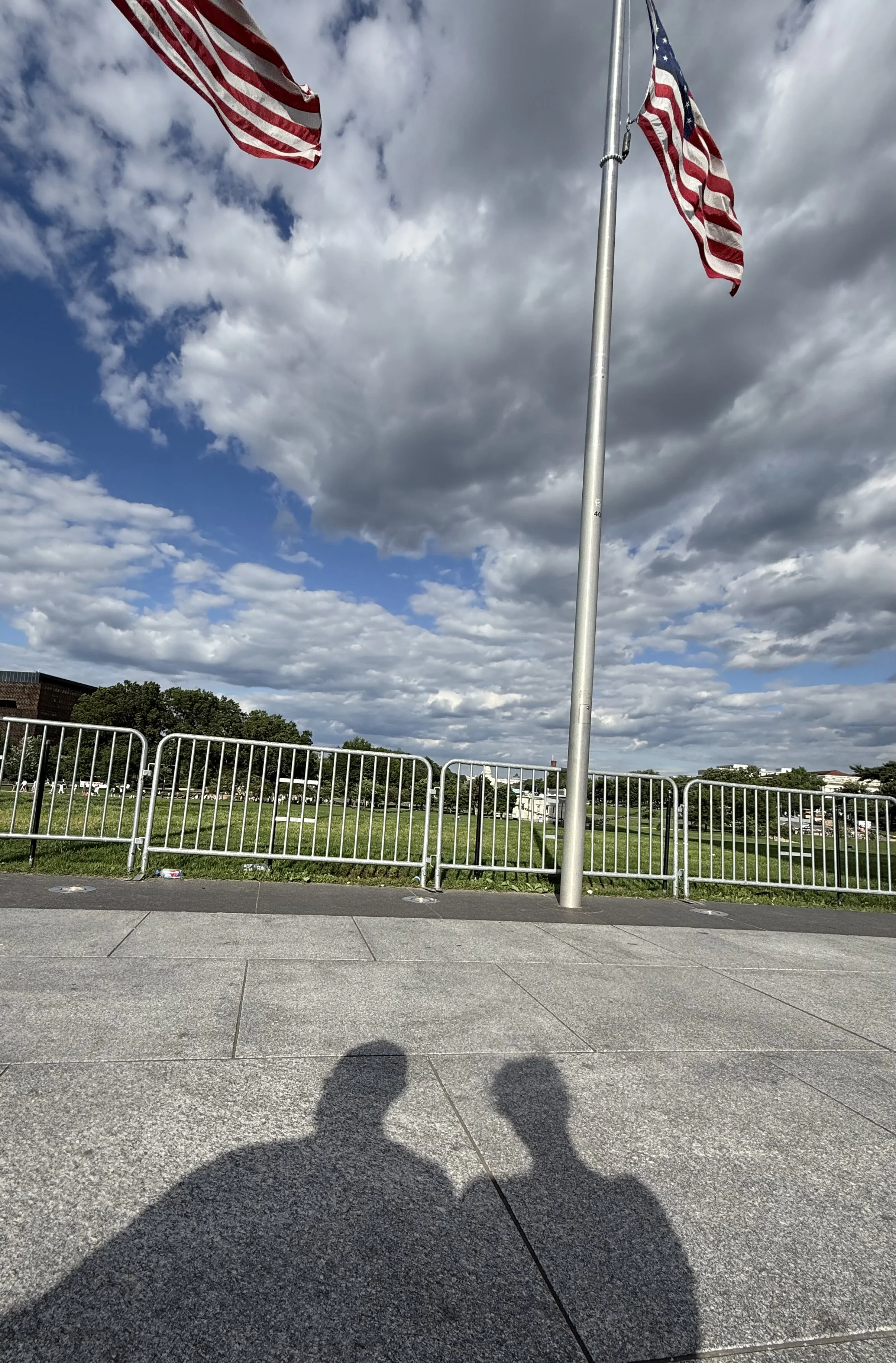
A view from the Washington Monument. | All 2026 images by Abril Warner.
Perhaps monuments function to be celebratory and forward-looking, while memorials are for mournful contemplation. If done well, public art holds space for both. My family moved from Takoma Park, Maryland in 1988, but some of the most cogent and enduring impressions were formed in the years we spent in the DC area. Many weekends were spent on the Mall or in the many museums that line it, such as the National Gallery of Art and the Natural History Museum. This June, we chose to look past the commotion and construction in Washington, DC, to appreciate some of the most famously memorable sights of the nation’s capital. We walked from the Lincoln Memorial to the Jefferson Memorial, then looped back on a 6-mile route that ended at the Vietnam Veterans Memorial. On this walk, I reflected on the people being memorialized, the values they championed, and the legacies they left behind. Yet I also came to an unexpected realization: aside from two artists, I know almost nothing about the individuals who envisioned and created these national landmarks.
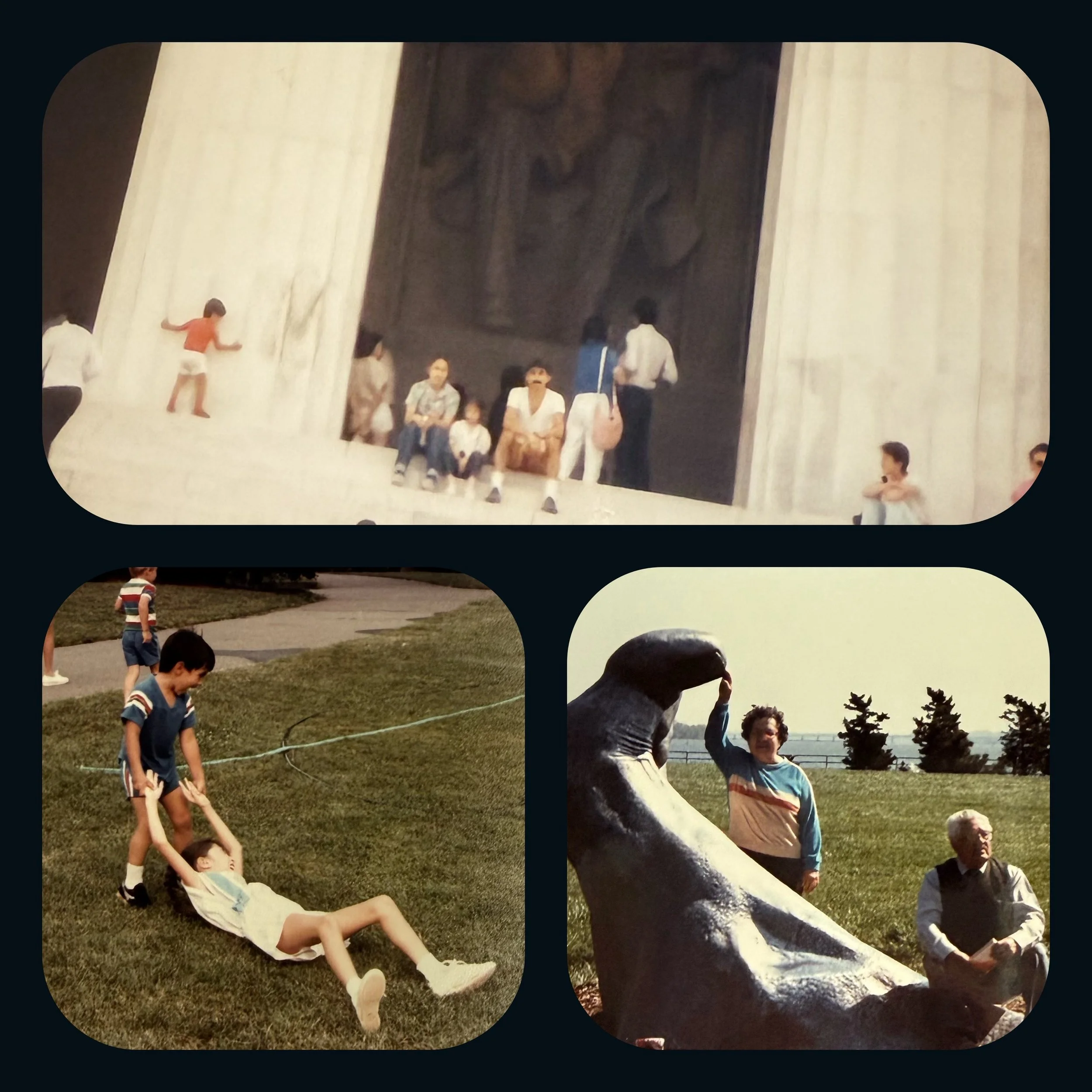
Circa 1987, top: At the Lincoln Memorial, little brother in red. Bottom left: Brother dragging me through sprinklers on the Mall. Bottom right: Grandparents at The Awakening by J. Seward Johnson, originally in DC (now at Oxon Hill, MD since 2008) [1].
Washington, DC was officially established as the capital of the United States in July 1790 [2]. The Lincoln Memorial and many DC memorials were inspired by the Neoclassical style which was the dominant art style during the Age of Enlightenment across much of Europe from the mid-18th century through the mid-19th century. Neoclassical art takes its cues from the Classical period, collectively the Ancient Greek and Roman cultures. The resurgence of this style in Washington, DC includes both compositional and philosophical elements, namely, the predominant use of symmetry, marble, and naturalism combined to celebrate man’s abilities. A newly formed, post-colonial (1776) and then post-Civil War (1865) U.S. sought to celebrate representative governance (Romanesque republicanism) and democratic participation (from the Ancient Athenians); and so, these ideals are reflected in the revival of Classical themes in much of DC’s memorial and monumental architecture.
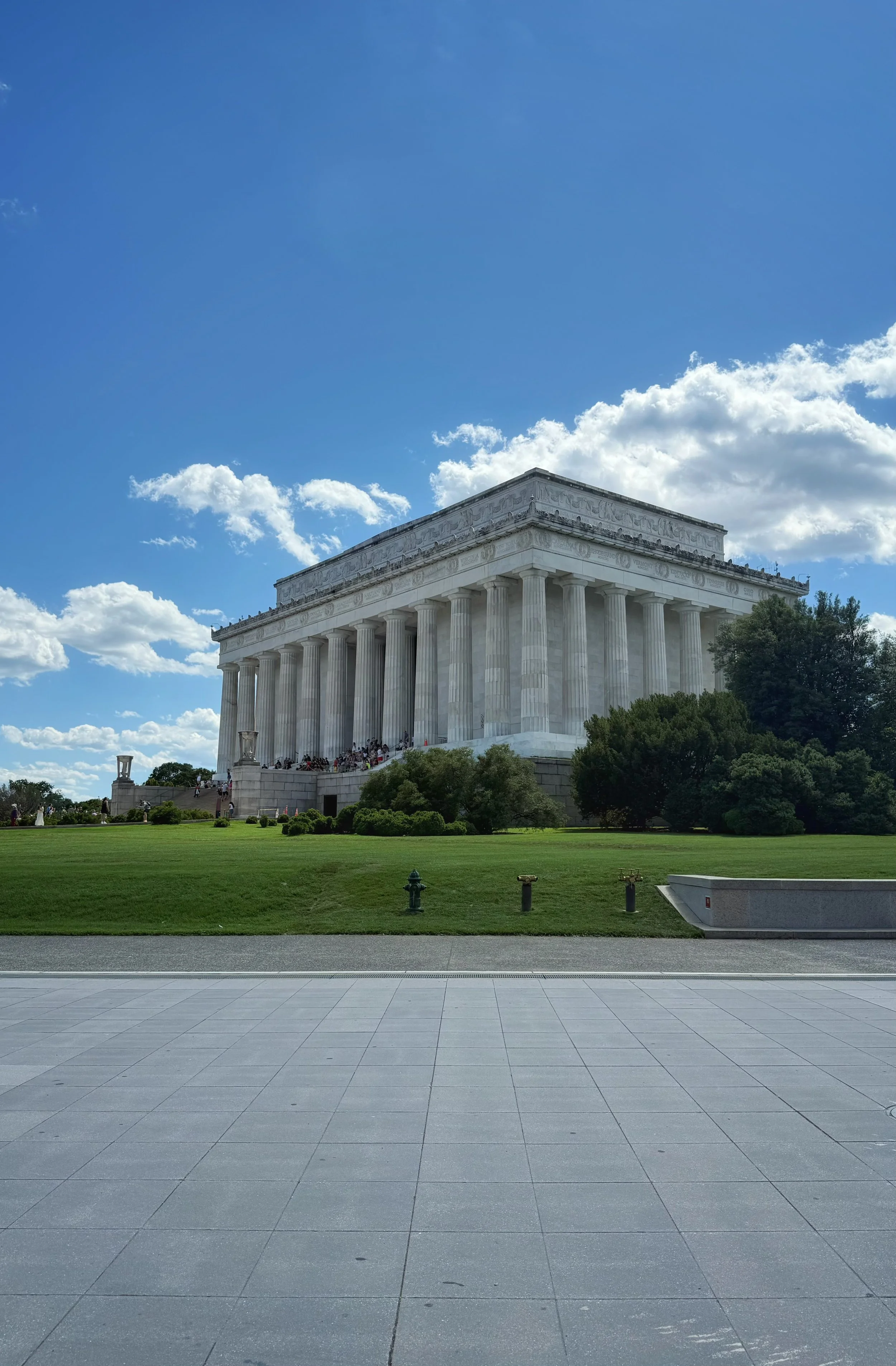
Lincoln Memorial, 2026.
The Lincoln Memorial
The Lincoln Memorial was opened to the public in 1922 [3]. The builders of this memorial included five artists an architect, two painters, and two sculptors, along with six brothers who handled all of the marble cutting. Henry Bacon’s main inspiration for the Lincoln Memorial was the ancient Athenian Parthenon. By sourcing all stone from within the United States, Bacon ensured the form-content encompassed not only its design and symbolic meaning, but also its material composition. In doing so, the memorial embodied Lincoln’s enduring legacy: the importance of the union.[4]
New Hampshire born, Daniel Chester French is responsible for the monumental marble statue of Lincoln. D.C. French’s first notable commission came in 1873 from the town of Concord, Massachusetts, for the bronze Minute Man; following that commission, he briefly studied art in Italy before returning to the U.S. to focus on public works [5]. For the Lincoln Memorial portrait, French relied on contemporary photographs, written accounts, and casts to capture the likeness and spirit of Lincoln, specifically, during the time of the Civil War [4]. Today, the nineteen-foot tall seated figure looks outward through massive Doric columns from the rear interior of the temple. One hand is clenched and the other is open. The sign at the foot of the throne asks for silence and respect.
In 1866, Jules Guerin was born in St. Louis, Missouri. By 1880, his family had moved to Chicago where he began artistic training, eventually leading him to study abroad. Upon his return to the U.S., Guerin’s steadiest work was in illustration both architectural and print; he is considered a giant of “American Illustration” alongside his friend Maxfield Parrish.[6] The work is colorful, atmospheric and reliant on meticulous linework. For the Lincoln Memorial, Bacon hired Guerin to complete two canvas murals (each 60 feet long by 12 feet high) one is Emancipation and the other Unity[4]. Each canvas is horizontally oriented and organized around a symmetrical three-part composition. At the center stands a gilded winged figure encircled by a cluster of attendants, while additional groups of figures occupy the spaces to either side. Together, these elements form allegorical scenes referring to the subject named in each title.
Ernest C. Bairstow is the English-born American sculptor who finished all the outer details such as states, wreaths and more. Bairstow also completed the lettering in the interior temple walls. [4]
Evelyn Beatrice Longman (1874-1954) holds the distinction of being the first woman to be elected as a full member of the National Academy of Design. Determined to become a sculptor, she studied at the Art Institute of Chicago and later with D.C. French in New York. Longman received a silver medal at the 1904 St. Louis Exposition for Victory, a sculpture depicting a male figure.[7] Hired by Henry Bacon, she executed all interior carving on the Lincoln Memorial, such as the palm fronds and eagles around the Gettysburg Address [4].
In 1888, a master stone carver from Massa, Italy, Giuseppe Piccirilli, moved his family to New York. Giuseppe and his six sons’ stone-cutting business took off, eventually dominating an entire city block and completing dozens of commissions throughout New York City, including the lions for The New York Public Library.[8] In 1918, French hired them to carve the 28 blocks of marble he would need to refine to complete the nearly seamless Lincoln.[4]
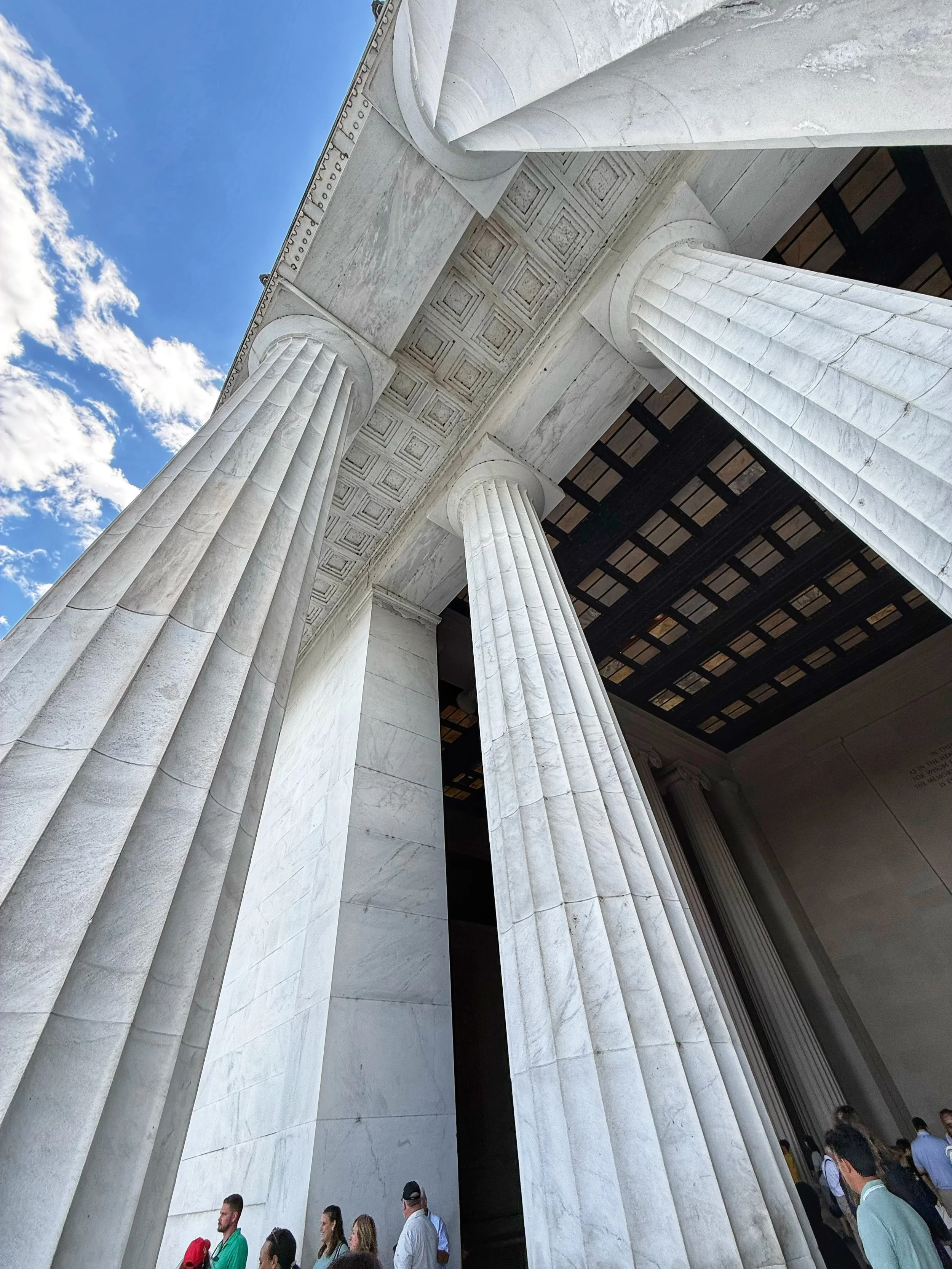
Lincoln Memorial, 2026.
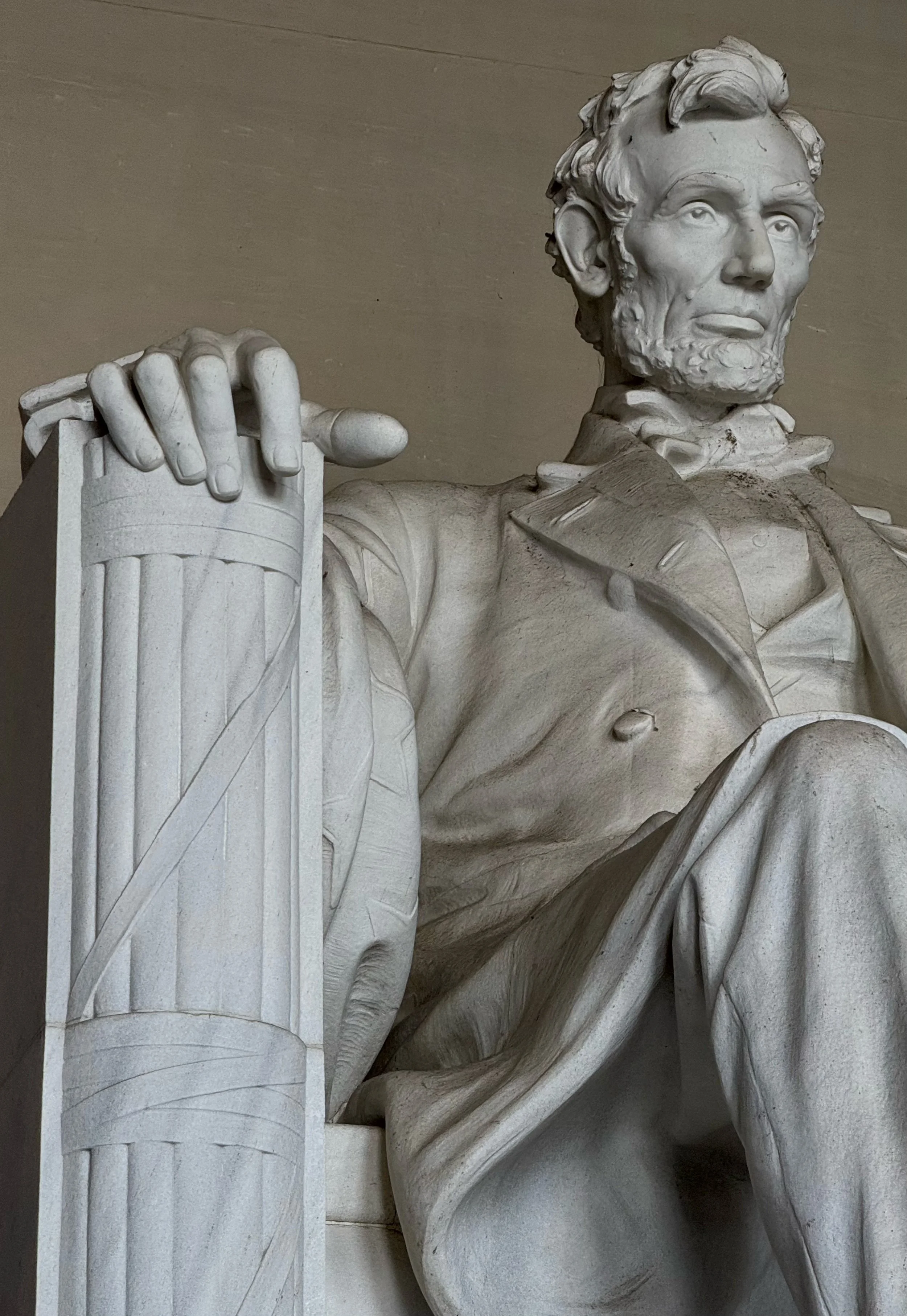
Lincoln Memorial, 2026.
The Thomas Jefferson Memorial
The Nacotchtank and Nameroughquena settlements existed long before Pierre L'Enfant drafted his 1791 city plan for Washington, DC. According to the National Parks Service, “Prior to this, American Indians utilized this marshy, estuary area, then part of Tiber Creek … for hunting and gathering.” Today, as many as four thousand Native Americans currently live in DC.[10]
In 1882, dredging of the Potomac River created two tracks of land. In 1912, the first cherry tree from Japan's gift of friendship to the United States was planted. In 1926, Congress authorized the construction of the Thomas Jefferson Memorial and later chose a site positioned on an axis with the White House. In 1943, the Jefferson Memorial was dedicated on Jefferson's 200th birthday. [11]
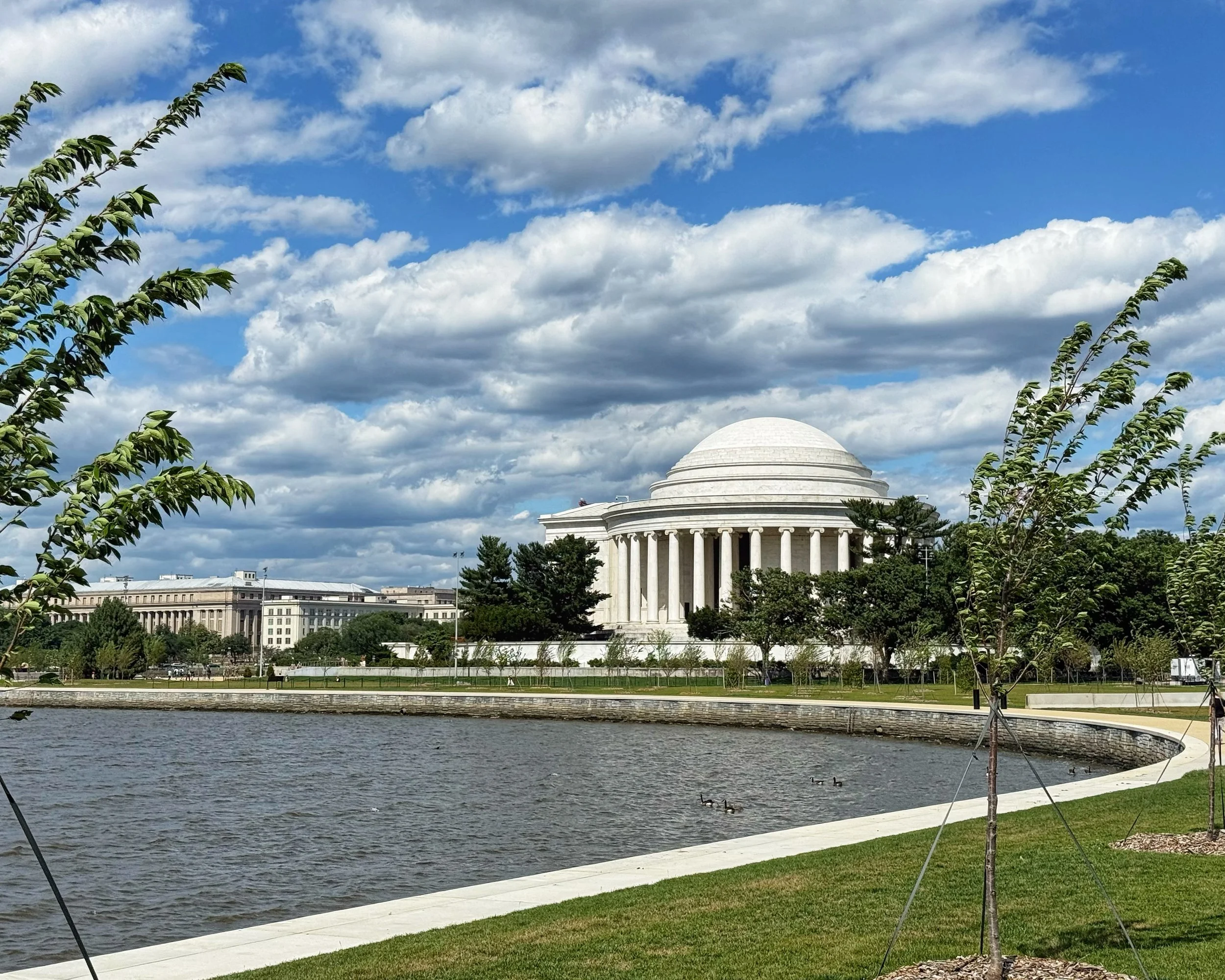
Thomas Jefferson Memorial, 2026.
John Russell Pope abandoned his medical studies before devoting himself to architecture. He earned a Bachelor of Philosophy in Architecture in 1894, then studied in Italy for a year and half, and completed his studies at the École des Beaux-Arts in Paris. Upon returning to the U.S., Pope established his own firm in 1903 in New York City. In 1910, he was hired to design the Temple of the Scottish Rite in Washington, DC.[12] Pope is known for his Classical style. His buildings often include: marble, symmetry, classical columns, pediments and domes.
In 1935, Pope was commissioned to design the National Gallery of Art (now known as the West Building) and the Thomas Jefferson Memorial. Both feature a rotunda, ionic columns, symmetry, and pediments, and both were completed after John Russell Pope died of cancer in 1937. In 1940, Adolph A. Weinman was hired to complete the relief on the north pediment of the Thomas Jefferson Memorial, depicting the signing of the Declaration of Independence. Interestingly, this artist had also completed the sphinxes on Temple of the Scottish Rite which was Pope’s first major commission in DC [13].
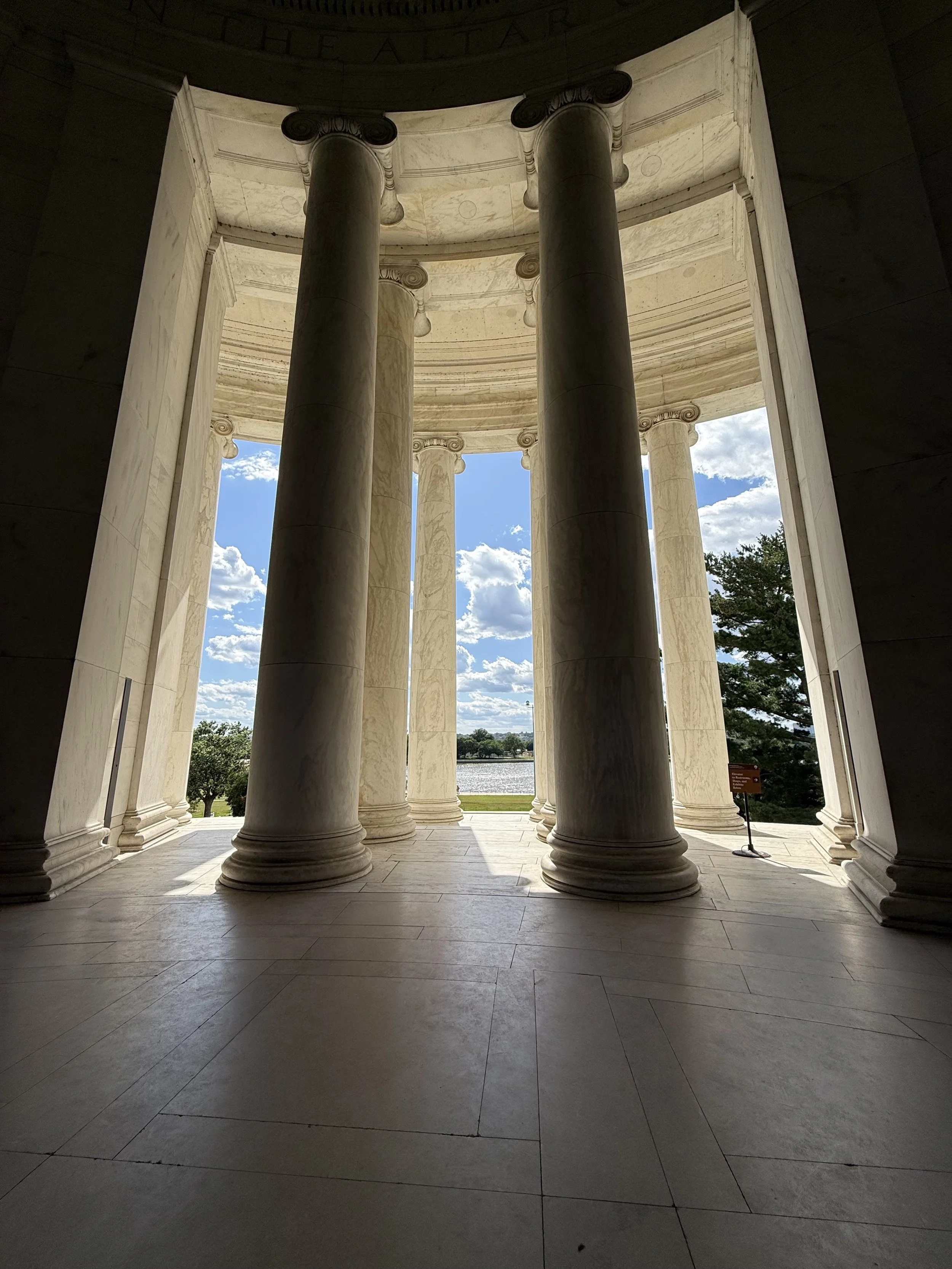
Thomas Jefferson Memorial, 2026.
In 1941, the DC- born artist Rudolph Evans (1878-1960) was commissioned to create the nineteen foot tall bronze statue of Thomas Jefferson. Showing an early aptitude for sculpture, Evans went on to study at the École des Beaux-Arts in Paris in 1897. Returning to DC in 1900, he took a temporary teaching appointment at the Corcoran Gallery of Art school before moving to New York where he spent several years mastering portraiture.[14]
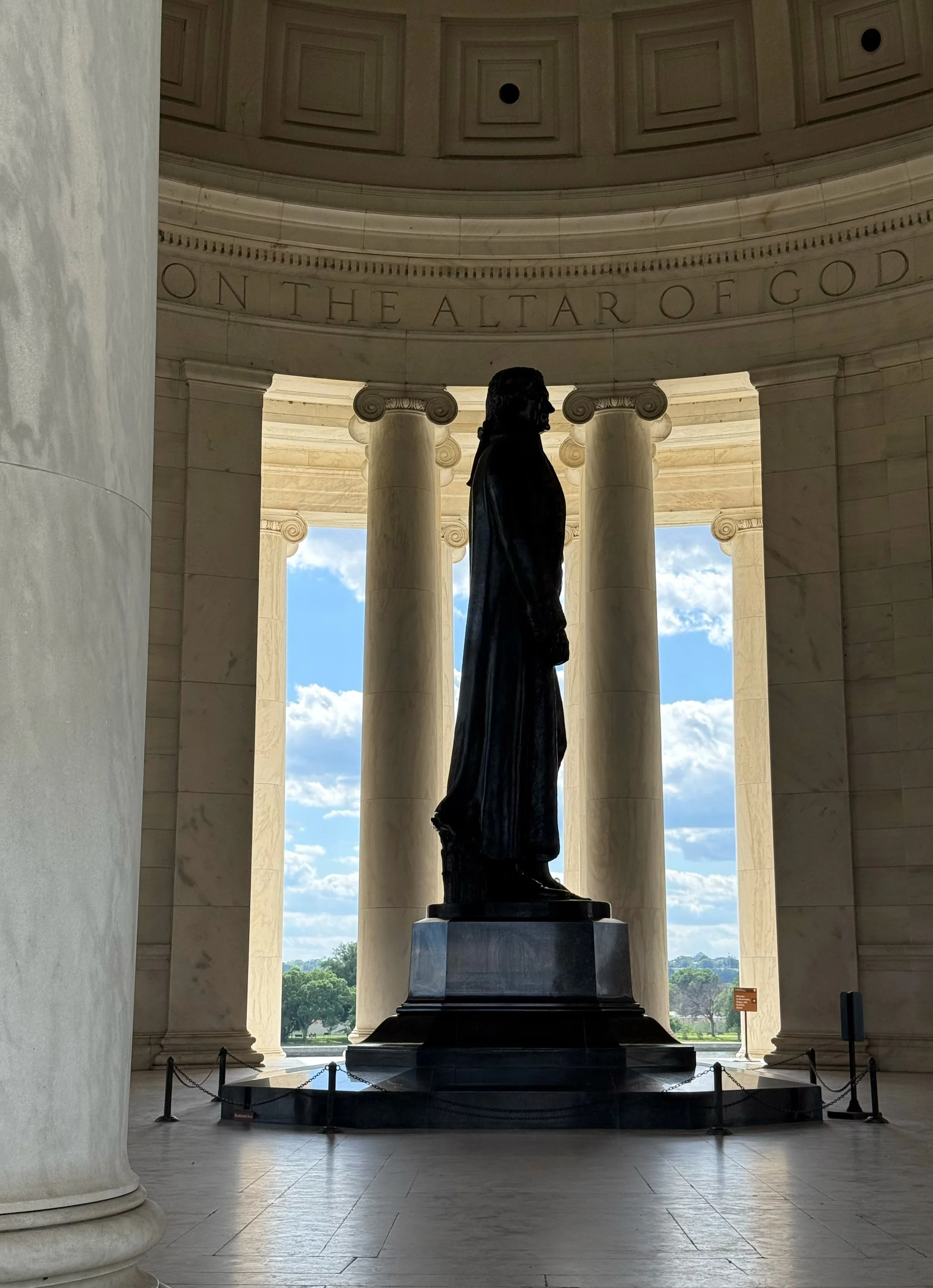
Thomas Jefferson Memorial, 2026.
Franklin Delano Roosevelt Memorial
The Franklin Delano Roosevelt Memorial was dedicated in 1997, almost ten years since my family moved away from the DC area. I was moved at the sight and space of the Lincoln Memorial and the Thomas Jefferson Memorial, both are part of my childhood and my understanding of history and art. I was unprepared to be moved to tears at the Franklin Delano Roosevelt Memorial. We walked from the Jefferson Memorial to the FDR Memorial, and therefore, we entered chronologically backwards through the memorial spaces.
The lead artist for the FDR Memorial was Lawrence Halprin (1916-2009), an American landscape architect and designer. Halprin began life in Brooklyn, NY, and he studied Landscape Architecture at the Harvard Graduate School of Design in 1942. After serving in the U.S. Navy during World War II, he started his own firm in California in 1945. In 2002, Halprin received the the National Medal of Arts.[15]
In 1974, Halprin was selected to design the FDR Memorial, and a design was approved in 1978. Lack of funding slowed the process until the groundbreaking in 1991. The dedication was in 1997.[16] The Prologue Room was added in 2001 with funding from donations given to the National Organization on Disability. This addition features the president in his wheelchair. The Franklin Delano Roosevelt Memorial has four “rooms” representing FDR’s four terms in office. The spaces are comprised of quotations and sculptural forms, tons of pink and gray U.S. sourced granite, and several bronze forms and figures.[17] Additional artists include: Leonard Baskin, Neil Estern, Robert Graham, Thomas Hardy, and George Segal [16].
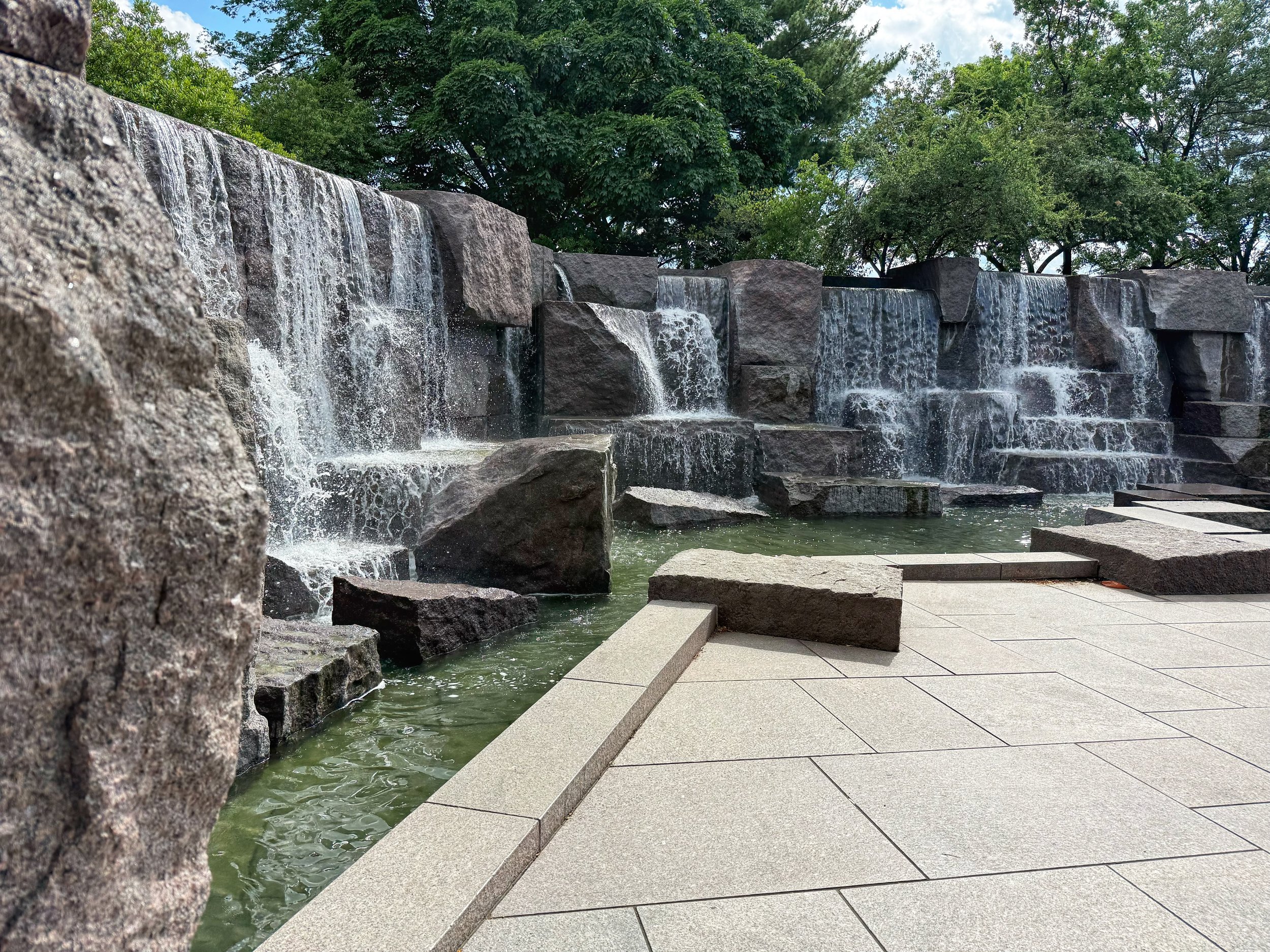
FDR Memorial, 2026.
Since we started at “the end”, we were met with the “Four Freedoms Fountain” which is water cascading from several granite rocks. Transitioning from that room, we encountered Neil Estern’s Eleanor Roosevelt, a bronze portrait depicting her standing in a frontal pose. On an adjacent wall, carved into granite is an FDR quote from 1943, “Unless the peace that follows recognizes that the whole world is one neighborhood and does justice to the whole human race, the germs of another world war will remain as a constant threat to mankind” [18]
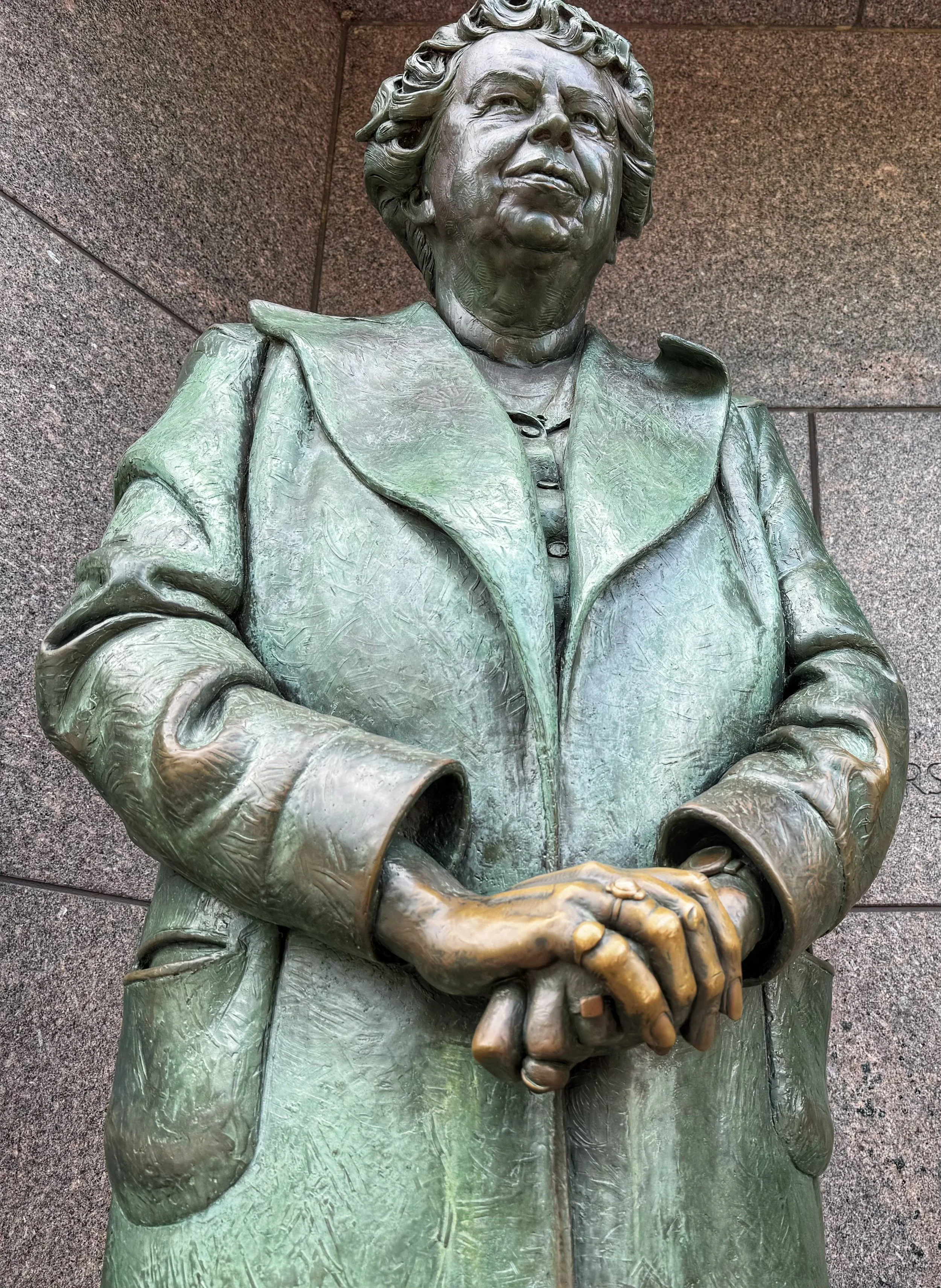
Neil Estern’s Eleanor Roosevelt at FDR Memorial. | Photo taken by Abril Warner, 2026.
The rooms all have smaller cascades or pools of water. In room 2, Robert Graham's Social Programs contains five free-standing columns covered in bronze reliefs and five bronze relief panels on the granite walls representing the FDR’s New Deal initiatives [19]. The reliefs have figurative elements (e.g. body parts and objects) and braille, designed to be touched by visitors. I found it to be a heady experience which has unexpectedly stayed longest in my thoughts than the other rooms. Robert Graham (1938–2008) was born in Mexico City, Mexico, and was raised California. Outside of California he exhibited in London, Hamburg, and Mexico City.[20]
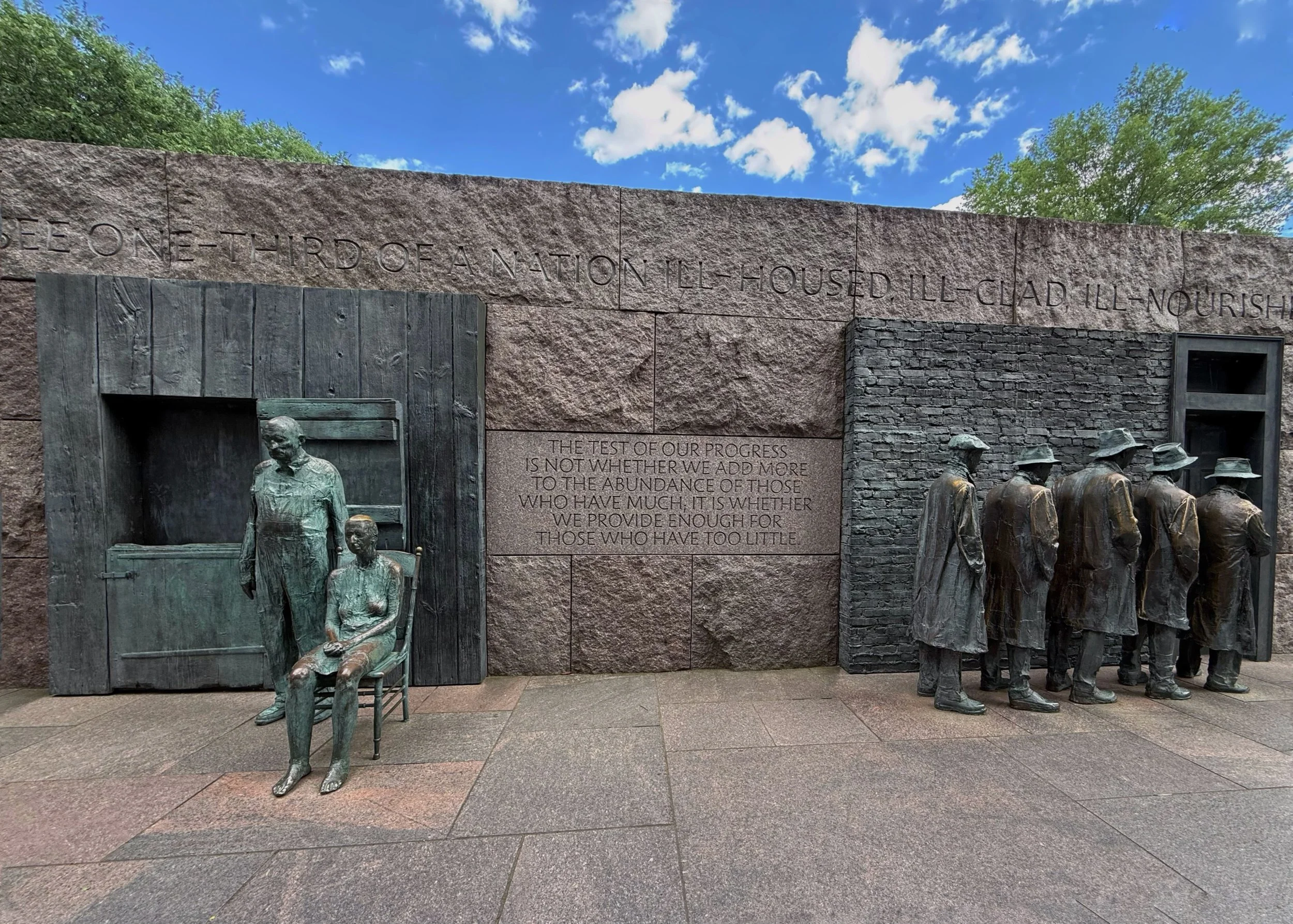
George Segal’s Appalachian Couple & The Breadline at FDR Memorial. | Photo taken by Abril Warner, 2026.
As we were leaving room 2, we encountered two works by George Segal, Appalachian Couple and The Breadline. I have seen several of his pieces in person before and instantly recognized them for what they were. Segal was born in New York and is, perhaps, best-known for his life-size figurative works in plaster and bronze. He is affiliated with American Pop Art, and in 1999 was awarded the United States National Medal of Arts.[21] The life-size scale of the figures creates a startling sense of immediacy, bringing the hardships of the Great Depression and the Dust Bowl into sharp focus.
And finally as we left room 1, we were left with this thought from a 1934 Fireside Chat, “No Country, however rich, can afford the waste of its human resources. Demoralization caused by vast unemployment is our greatest extravagance. Morally, it is the greatest menace to our social order” [18].
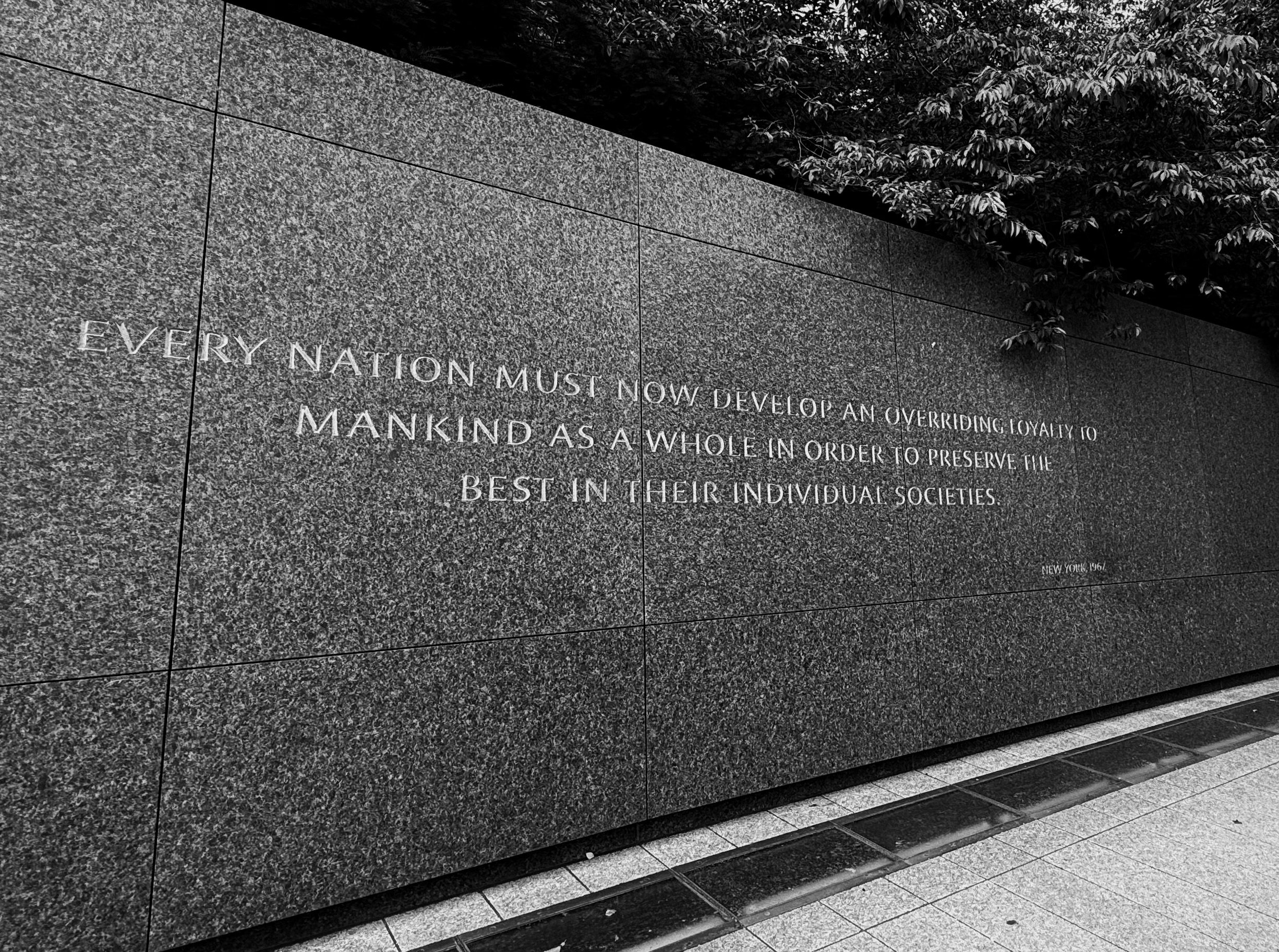
Martin Luther King, Jr. Memorial, 2026.
Martin Luther King, Jr. Memorial
Neighboring the FDR Memorial is the Martin Luther King, Jr. Memorial. This memorial stands between the Lincoln Memorial at the back and the Jefferson Memorial to the front. The MLK Memorial opened in 2011. Congress approved the creation of the Martin Luther King, Jr. Memorial, and in 2000, the ROMA Design Group’s plan prevailed [22]. The Memorial has three main parts. The first, is a curved outer wall made of smooth, dark granite with 14 excerpted inscriptions by Martin Luther King, Jr. At the center of the curved inscription wall is a simulated mountain range with a missing block. This third element symbolizes a stone emerging from the mountain to form the focal point of the memorial. Both the mountain and isolated block are made of pink and white granite.
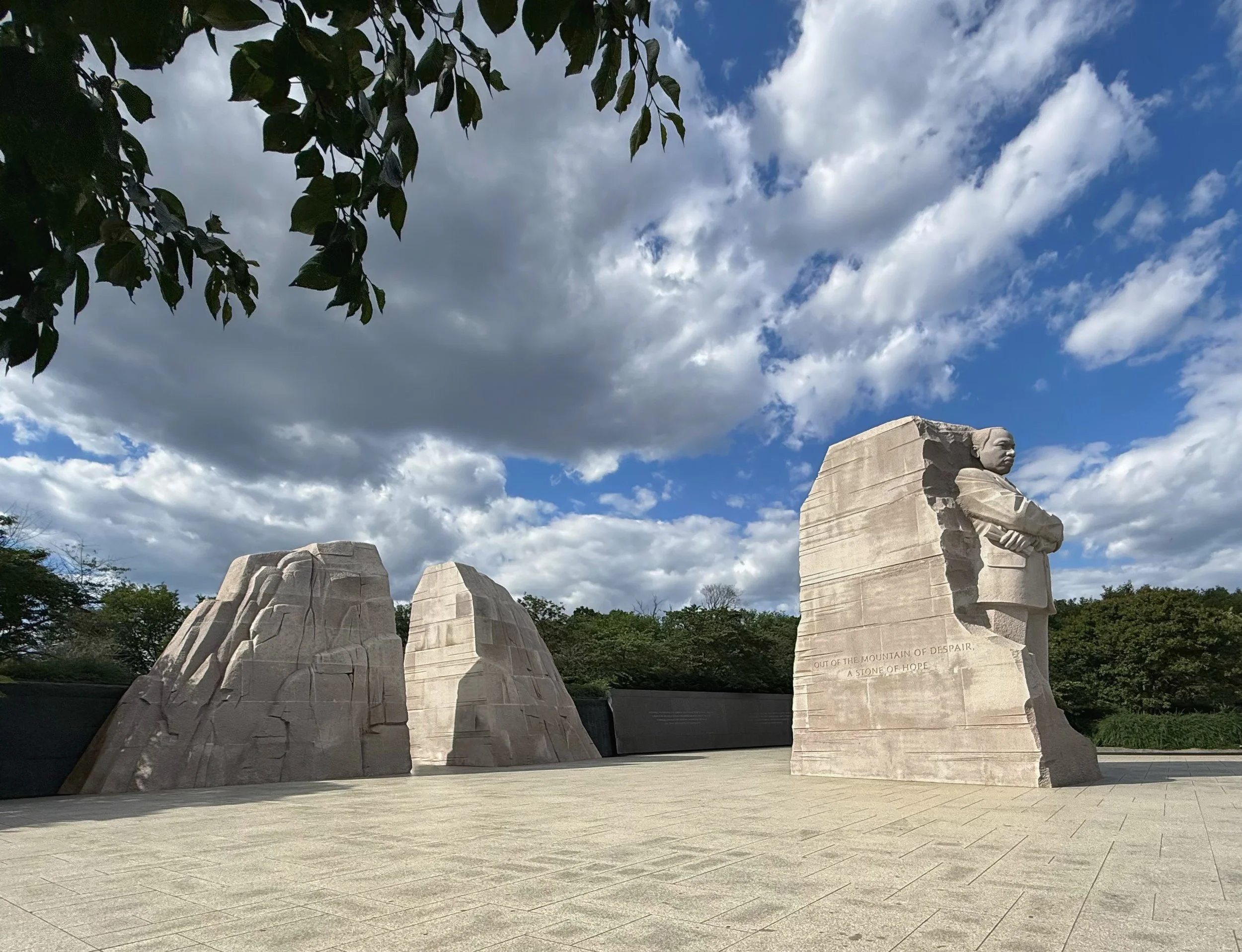
Martin Luther King, Jr. Memorial, 2026.
The tallest part of the MLK Memorial (thirty feet tall) is the isolated stone which faces the Tidal Basin. On both the isolated stone and the mountain, deeps ridges indicate the sliding and separation of the block. In 2007, Chinese master, Lei Yixin (b.1954), became the official sculptor to carve the likeness of Martin Luther King, Jr. on the solitary stone. Dr. King’s 1963 “I have Dream” speech, is reflected in this monument, “With this faith, we will be able to hew out of the mountain of despair a stone of hope.”[22]
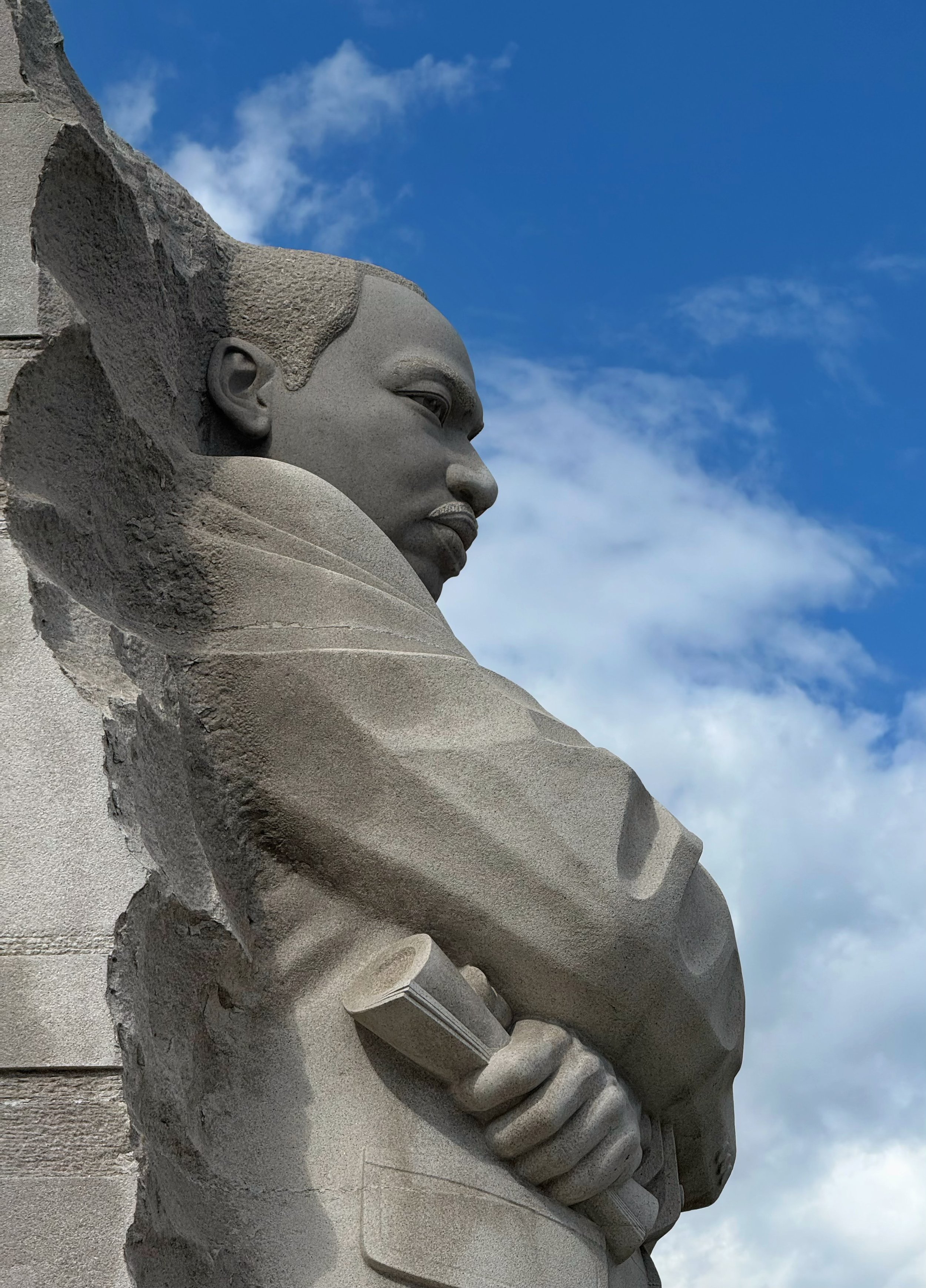
Lei Yixin’s Martin Luther King, Jr. at the MLK Memorial | Photo taken by Abril Warner, 2026.
A Couple More Moments
The fifteen-minute walk stretched considerably longer because of our meandering pace and frequent stops along the way. As we made our way from the Martin Luther King, Jr. Memorial to the Washington Monument, we paused at the small circular open-air Doric peristyle of the District of Columbia War Memorial, which honors District residents who died in World War I. Then we came to the World War II Memorial, enjoying its fountain and the striking view of the Lincoln Memorial framed beyond the water. We slowly climbed the gentle rise toward the Washington Monument. As we looked east toward the Capitol, a high school tour group behind us began singing hymns, adding an unexpected soundtrack to the scene.
We headed west to the see Maya Lin’s design, the Vietnam Veterans Memorial. We completed the loop in about three hours.
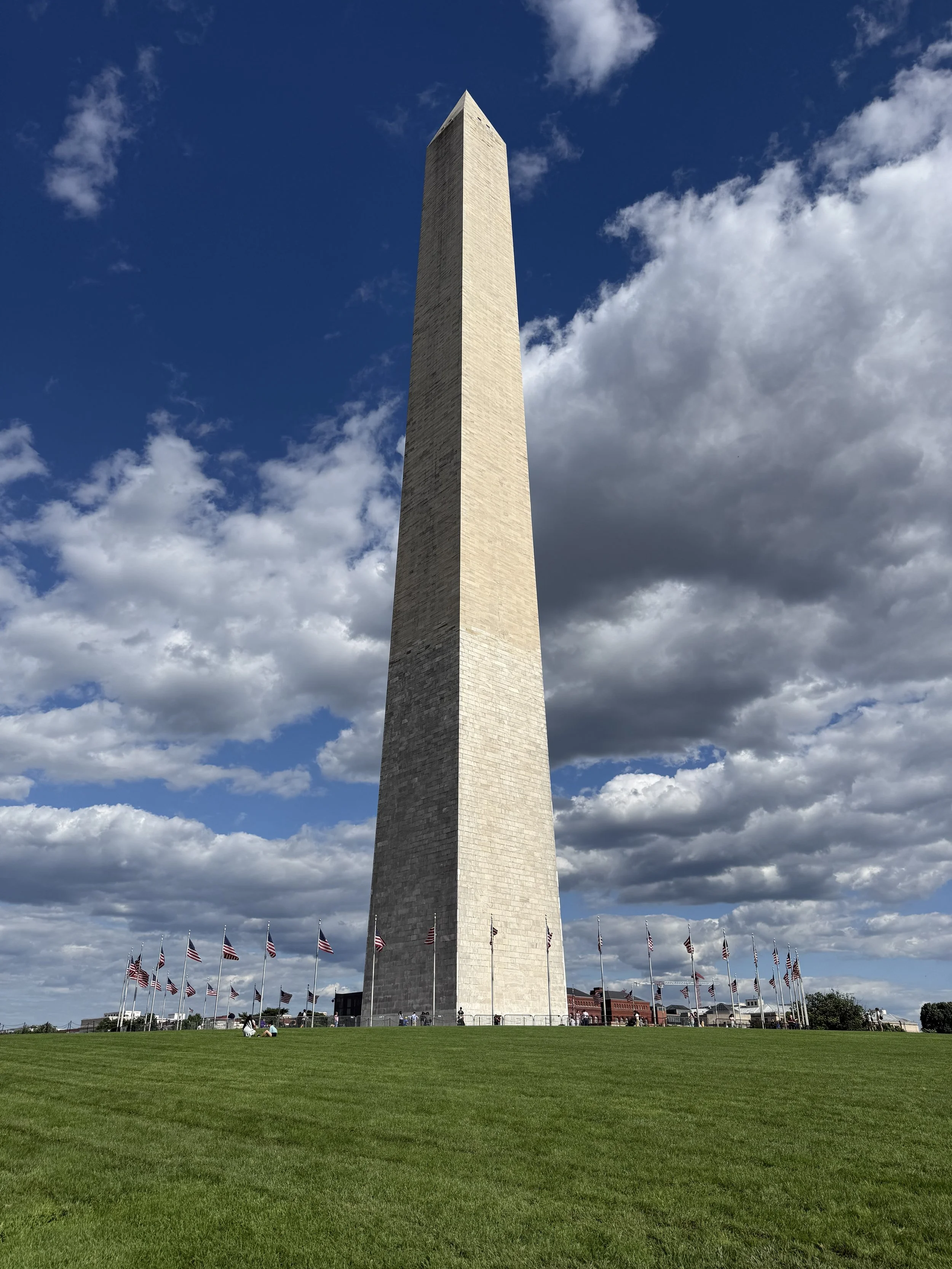
The Washington Monument, 2026.
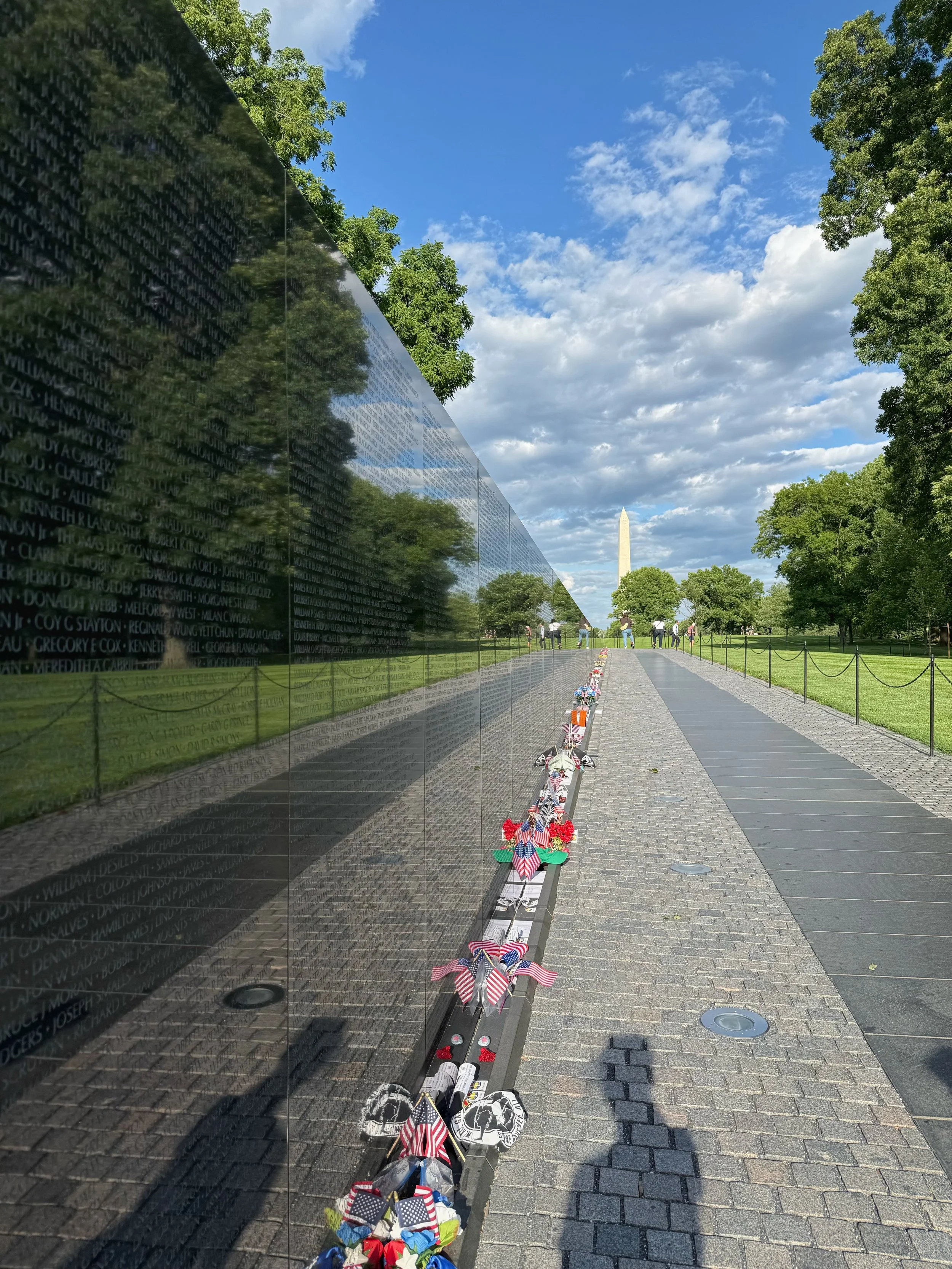
A view of the Washington Monument from the Vietnam Veterans Memorial, 2026.
The following is a map from the Moon Travel Guides with the yellow highlight roughly indicating the course we travelled.
Note: Due to the extensive construction going on throughout DC, access to the Mall was limited, so we missed such things: the Korean Veterans War Memorial, the Reflecting Pool, the White House, etc.
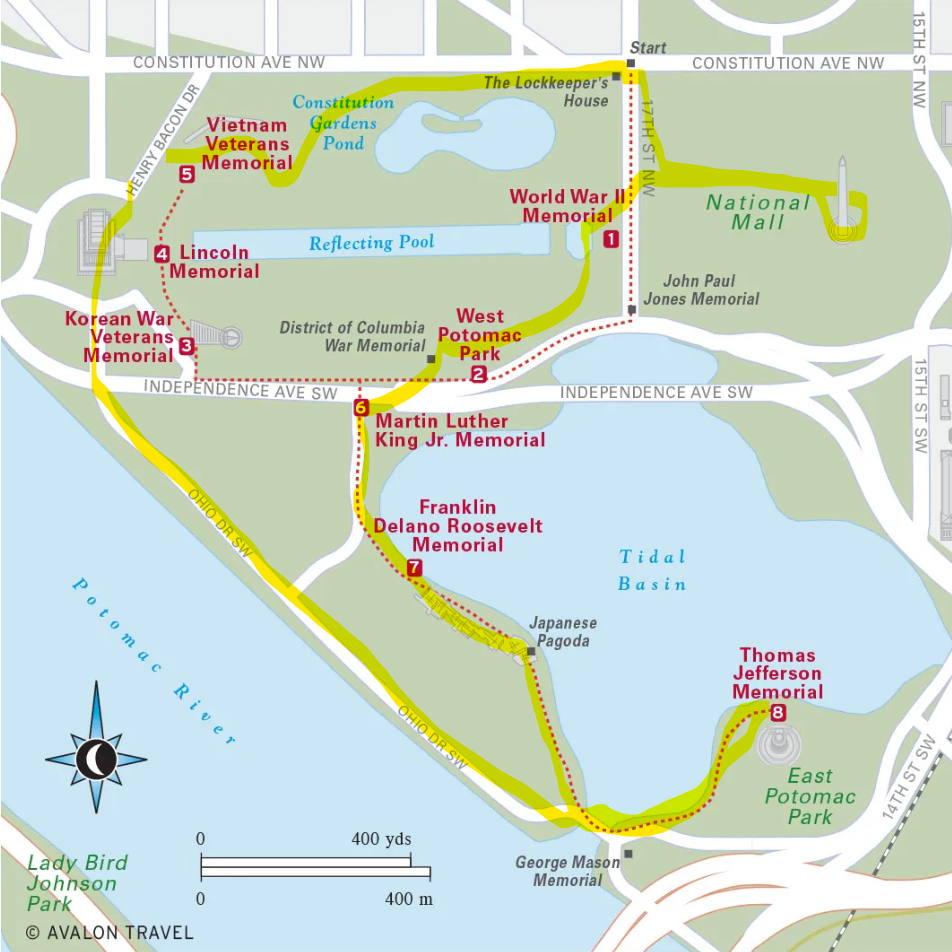
Map from the Moon Travel Guides with the yellow highlight roughly indicating our course, 2026.
For more information about the landmarks, artists, and the DC area please follow the links throughout and below.
Source: