
Florence Revisited: Galleria dell'Accademia di Firenze
This is the second installment of Florence Revisited.
At the risk of oversimplification, the Galleria dell'Accademia was organized in the late 1780’s, then later reorganized under the first Grand Duke of Tuscany Pietro Leopoldo, and then again when Napoleon suppressed the churches and charities in favor of a more “enlightened” centralized governing body. The Accademia, as we know it, was part of a restructuring of the Florentine Academy of Fine Arts which was originally founded by Cosimo I de ‘Medici in 1563 (a distant cousin of Cosimo, the elder). This building now houses important Proto-Renaissance Italian paintings and sculptures, and of course, the reason we stood in line for over three hours in 2013, Michelangelo’s David. [1]
All I clearly remember from the first visit are three things, waiting in line, seeing the Slave Figures and David. Honestly, the Slave Figures and David were enough to motivate me to return. Having more time on this visit, I spent a lot of time in the smaller painting galleries off of the main hall. My favorite was the one dedicated to Giotto and his followers.
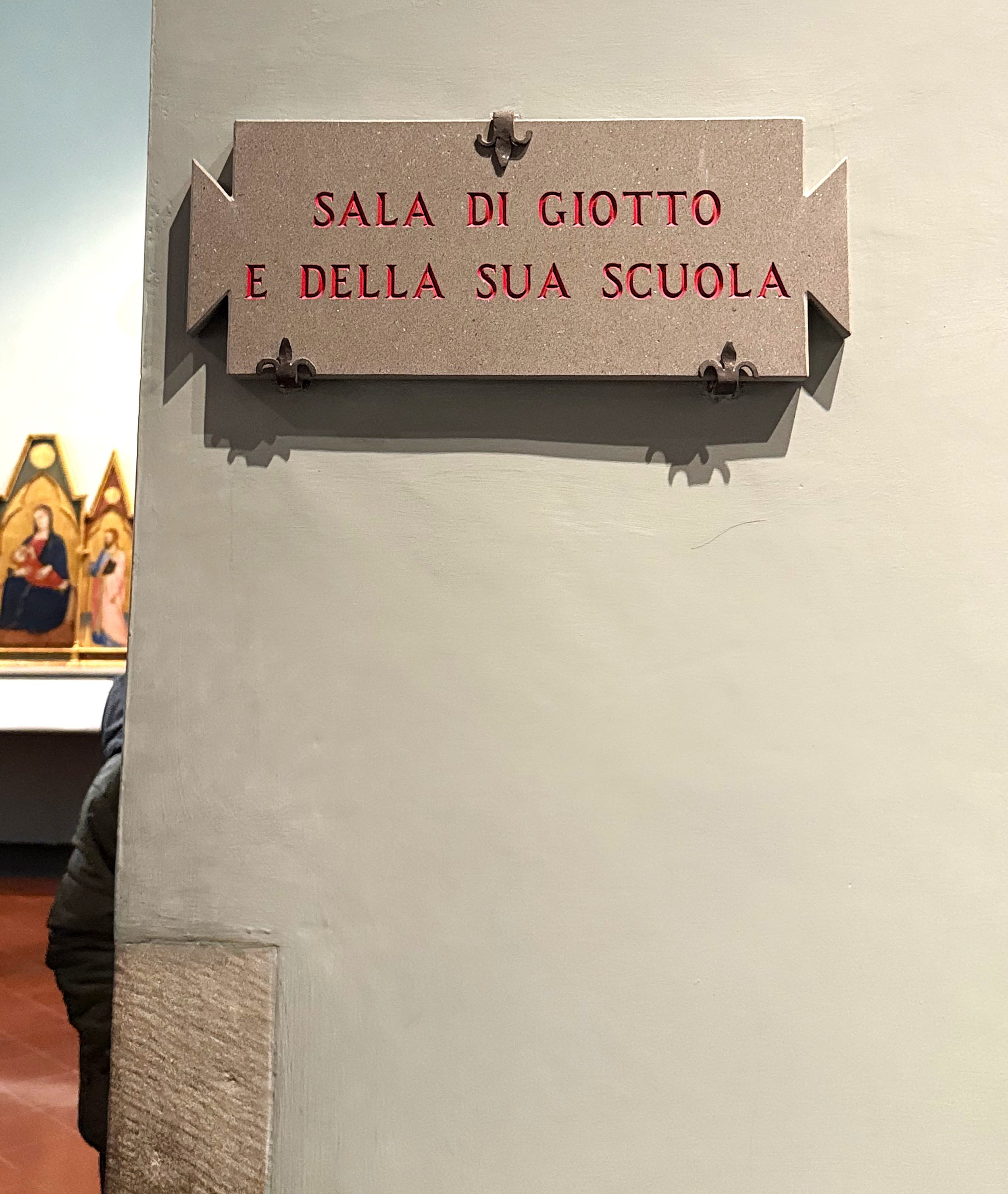
Giotto’s gallery within the dell'Accademia.
All images by Abril Warner, 2026.
Giotto (b.1267? -1337) is often cited as the father of modern Western painting. He was probably a student of Cimabue who broke ground, and started moving away from the Maniera Greca, or Byzantine style, which had dominated Italian Medieval painting. Even so, when compared to Cimabue, Giotto made notable strides toward the eventual Italian Renaissance. He placed naturalistic figures in believable compositions instead of against gold leaf backgrounds, and used gradual shifts from light to dark to model forms instead of using geometric striations.
Some of his works are attributed only to his workshop, as some are unsigned or too badly damaged to identify with certainty. Giotto’s career spanned from before the turn of the century through the 1330s.
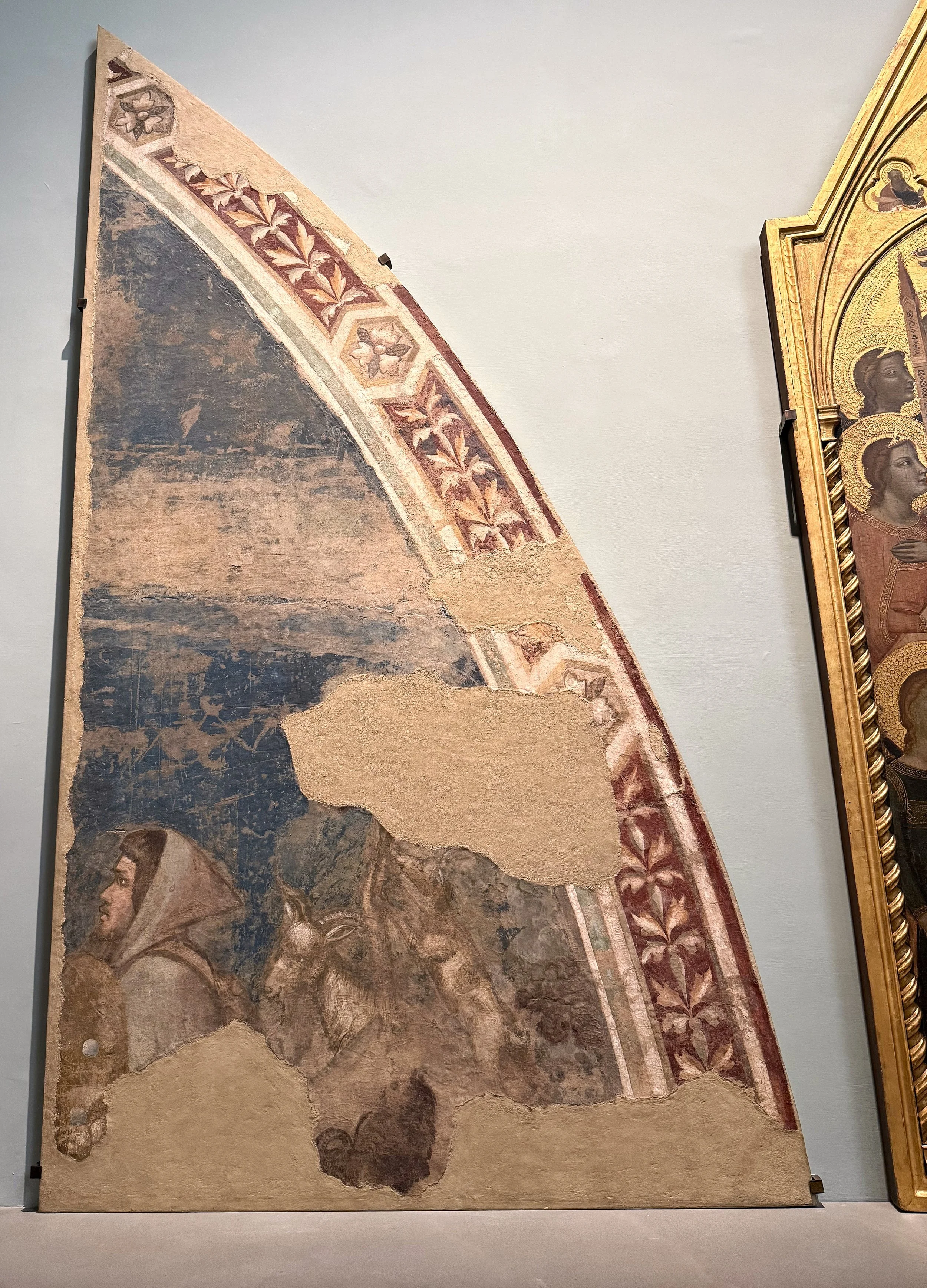
Giotto’s use of ultramarine blue for backgrounds is highly influential and revolutionary. | Head of a Shepherd and Herds, detached fresco mounted on metal, Giotto, c.1315-1325, Galleria dell'Accademia.
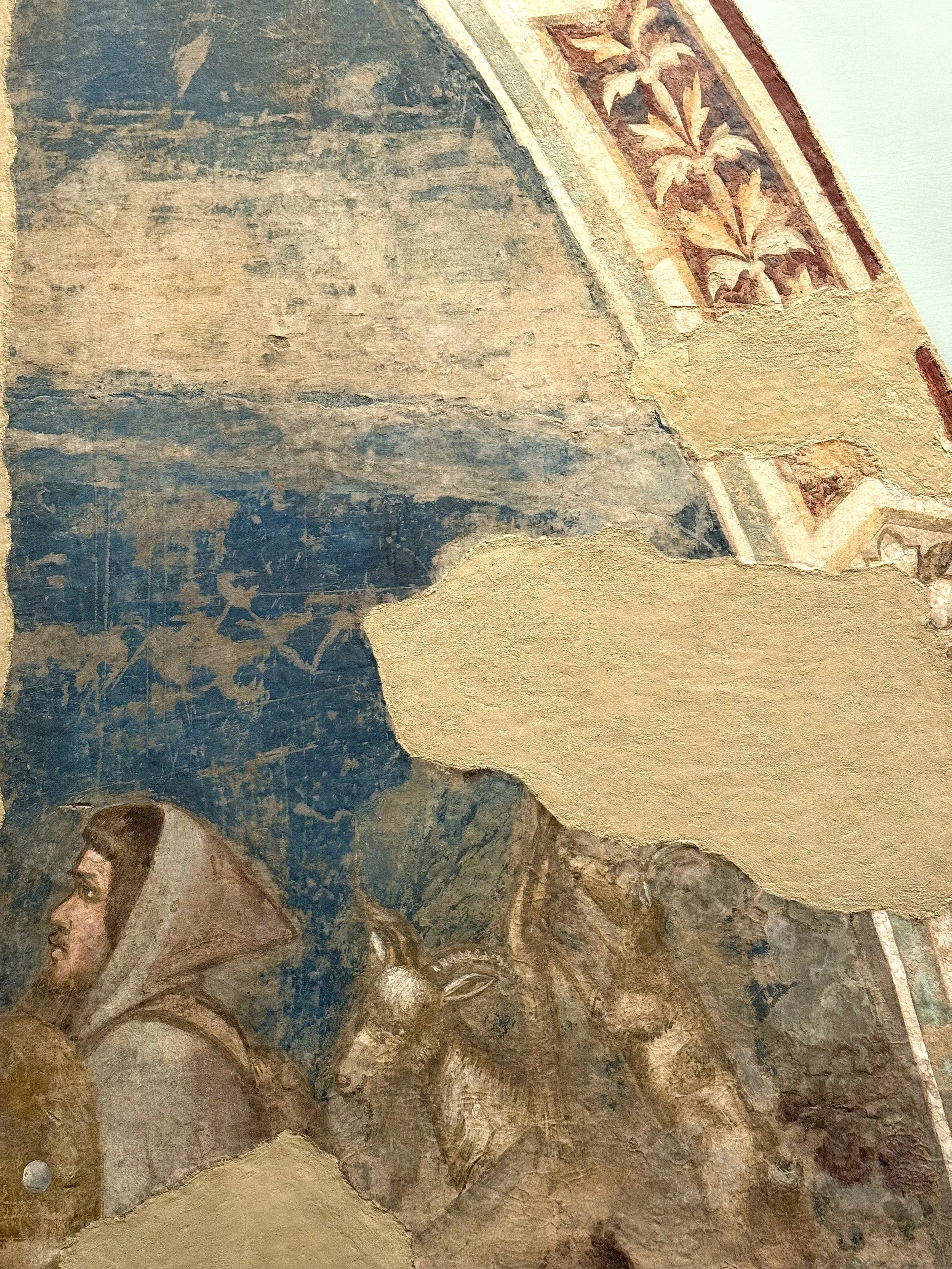
Head of a Shepherd and Herds, detail with figures.
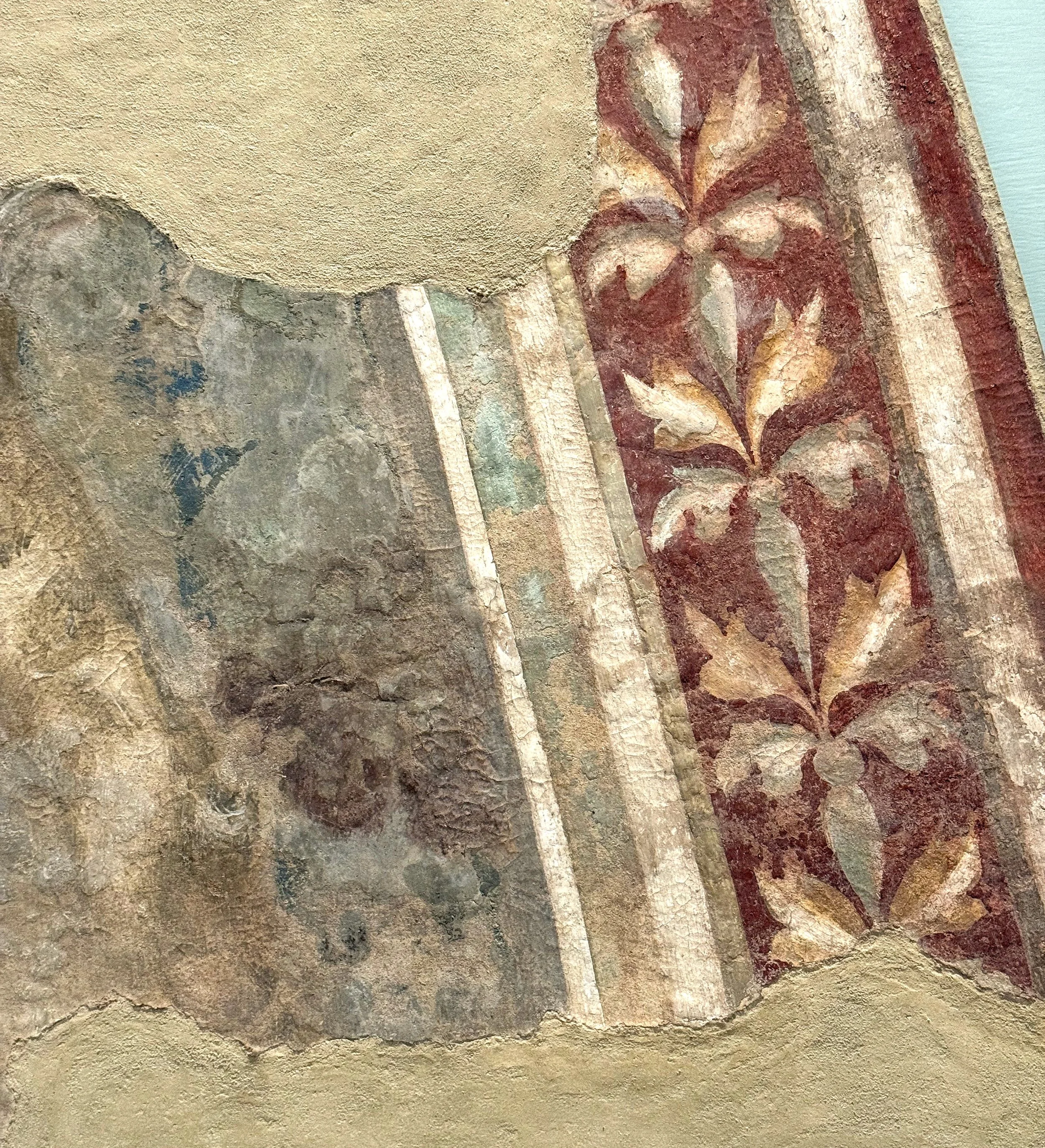
Head of a Shepherd and Herds, detail.
The example by Gaddi (below), has a gold-leaf background and the quatrefoil framing are like that of the Byzantine style, but the naturalistic elements make it apparent that Giotto’s influence is felt throughout. The shading on the buildings, trees, and clothing, along with the believable landscape on which Saint Francis kneels, helps bridge the gap from the Maniera Greca to the Proto-Renaissance.
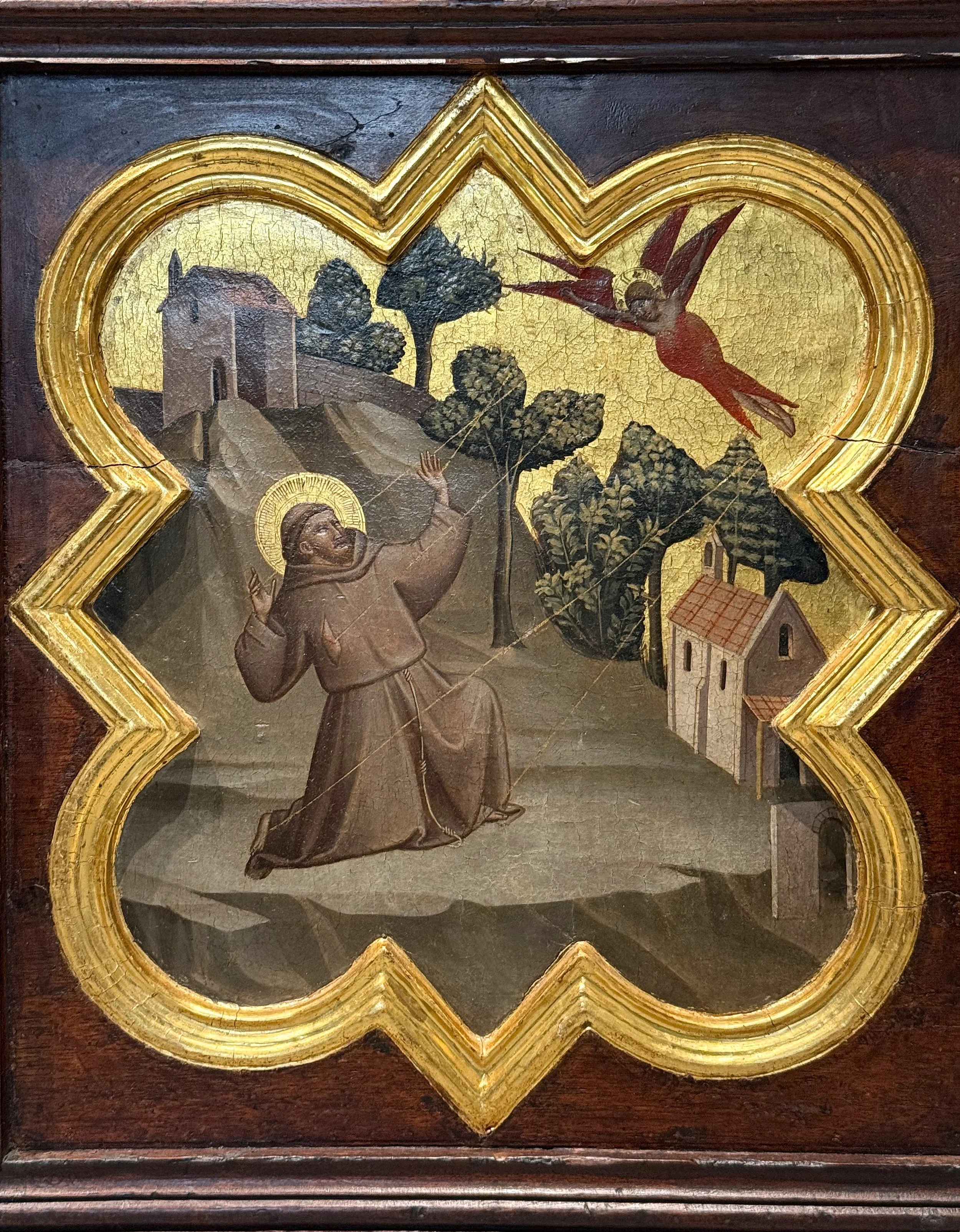
Saint Francis Receiving the Stigmata, Taddeo Gaddi, from Santa Croce, c. 1340, Galleria dell'Accademia.
The example below, by a master only known as a “master of the representation of Mary Magdalen”, reflects the artist’s mature style [1]. This work is firmly in the Byzantine demonstrating qualities of the style such as having a gold-leaf background, stylized figures, compartments, and geometric striations rather than modelling.
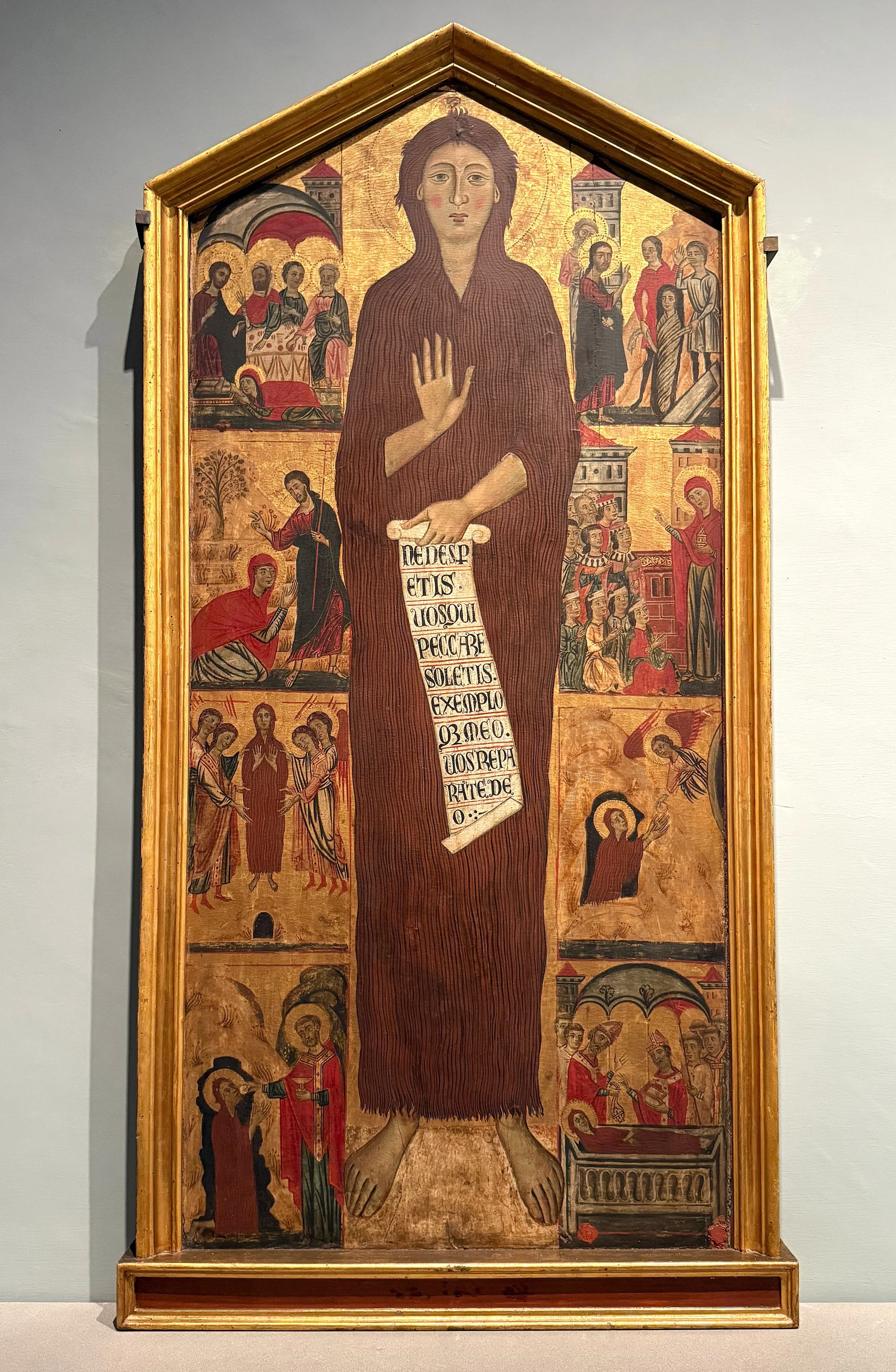
Repentant Magdalene and Eight Stories of Her Life, Maestro della Maddalena, c. 1280, Galleria dell'Accademia.
The obvious draw to the Accademia are Michelangelo’s Slave Figures and David. The Slave Figures offer much insight to Michelangelo’s methods to working in marble. His figures twist out of the raw blocks of marble. The pockmarks left by Michelangelo’s hammer and chisel remain visible; the texture reveals both the difficulty of the process and his masterful skill. These unfinished works are as close to a lesson from this Renaissance master as I will get. They remain firmly my favorite part of the Accademia experience.
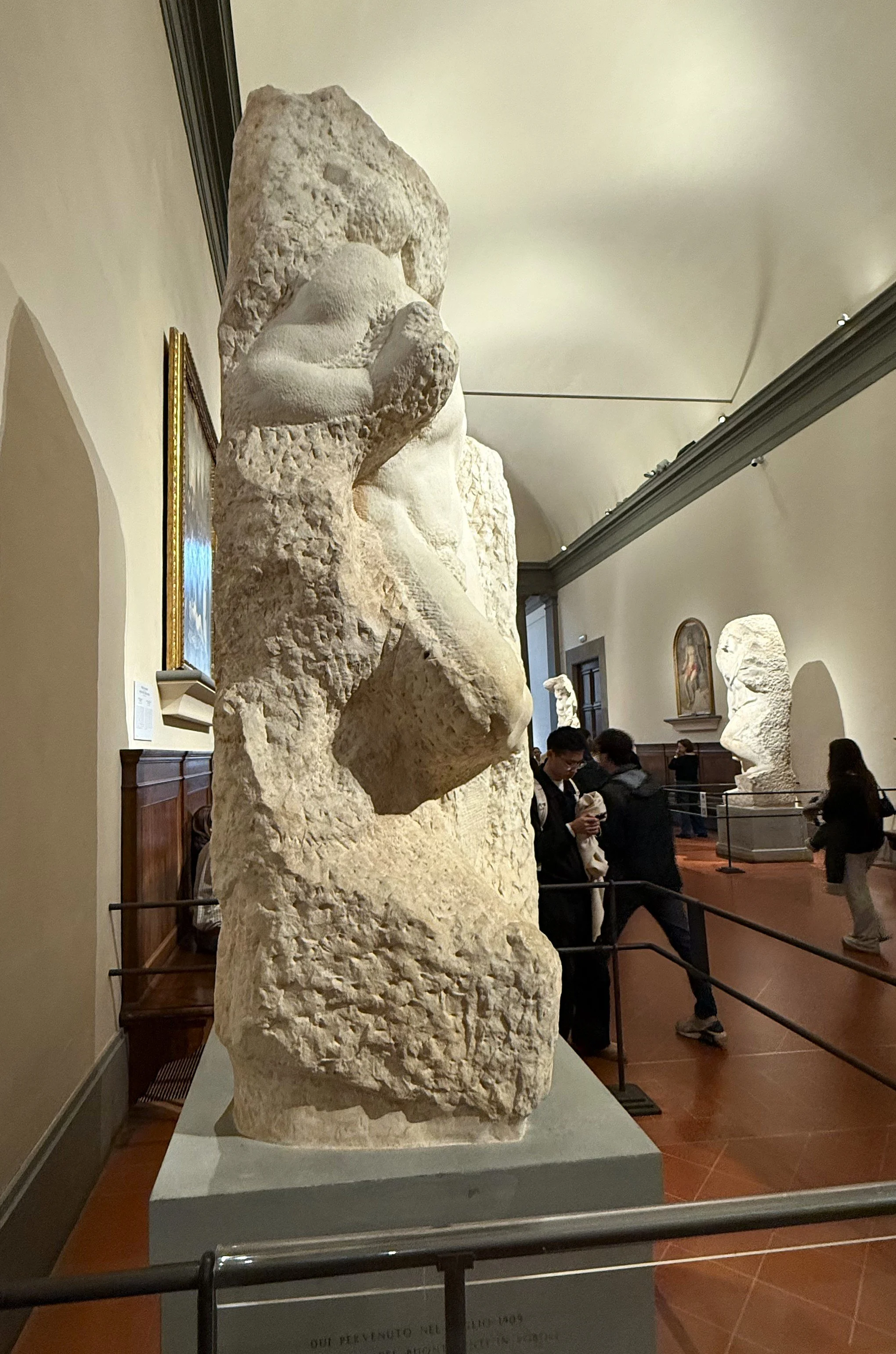
Awakening Slave, Michelangelo, marble, c. 1525–1530, Galleria dell'Accademia.
Two master sculptors had already rejected the block of marble that we would come to know as Michelangelo’s David, citing its imperfections as unworkable. Michelangelo was 26 years old when he started David. Its intended home was the Florence Cathedral (il Duomo). However, when it was unveiled in 1504, it was decided, that this symbol of the Florentine Republic was simply too majestic to sit on a roof line. So, David was moved to the most important plaza in Florence, the Signoria (in front of the Palazzo Vecchio). However, in 1847, the then Grand Duke of Tuscany, Leopold II, commissioned a master copy to stand in the Signoria and had the original moved to its present home [2]. David now stands at 17’ tall, keeping watch for any sign of danger from the safe confines of the Galleria dell 'Accademia.
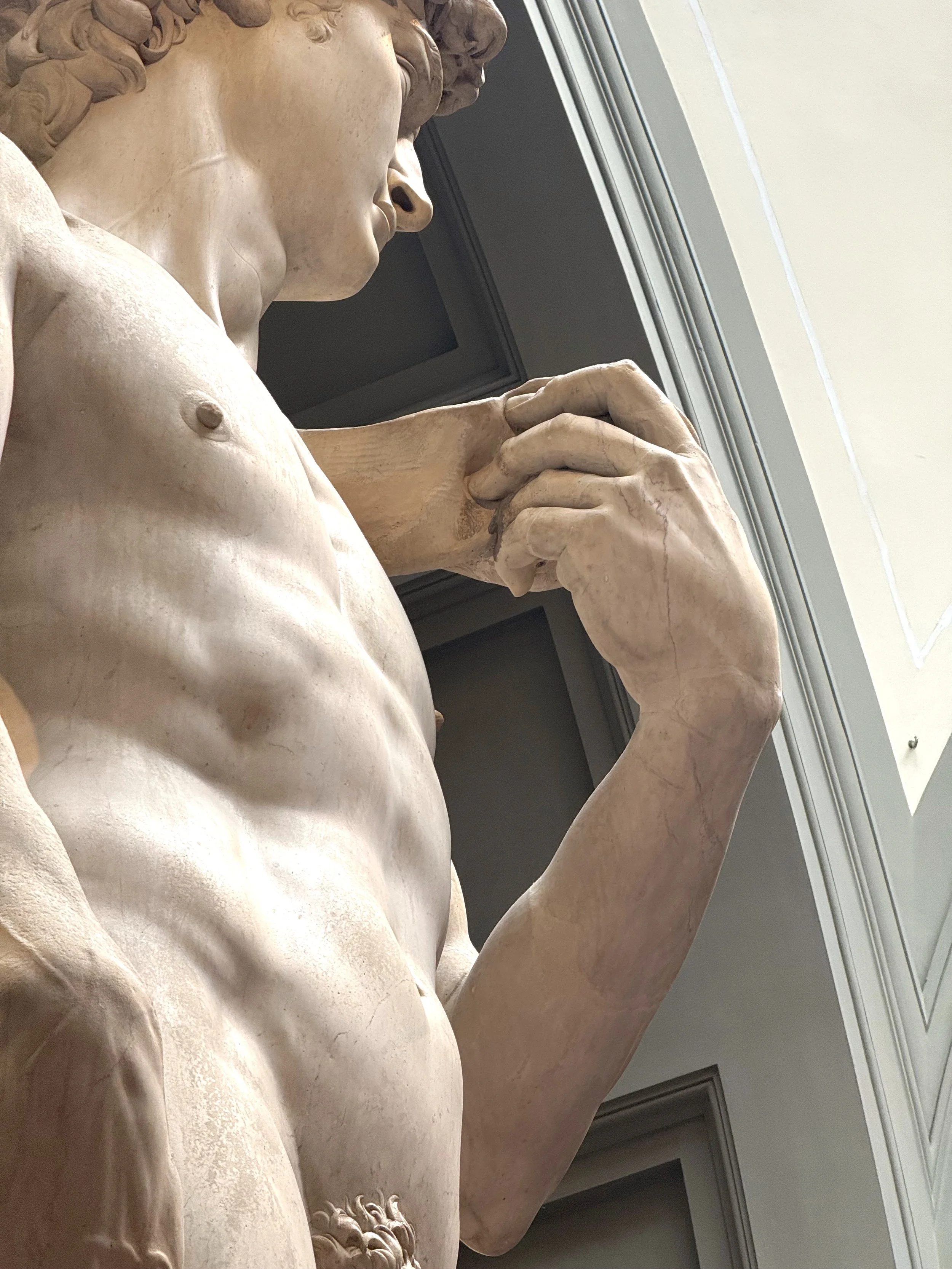
David, Michelangelo, marble, c. 1501–1504, Galleria dell'Accademia.