Artist Spaces: The Studio
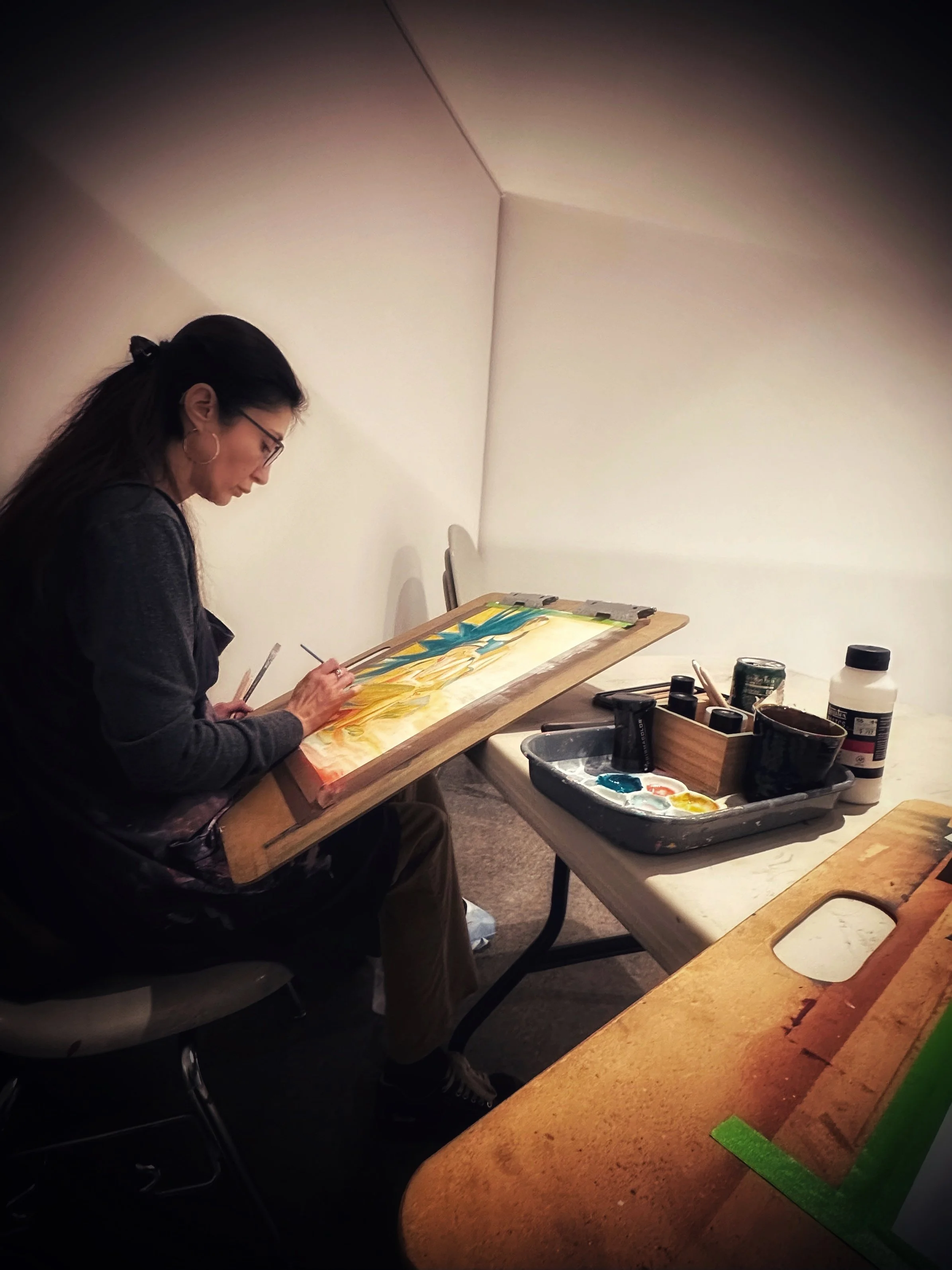
Abril at STL Guild by Jasmine Quintana.
As an undergrad, I was told that art does not exist until it is seen by the public, and that the artist’s studio is a manufactured, therefore an unnatural, space. Kurt Vonnegut told me to make art, “no matter how well or badly”; he even challenged to write a poem, then tear it up, trash it, and not share it. [1] There is something so freeing about the practice of art as an exercise in spiritual growth that is without judgement from the outside. The artist studio, at its best, is a space that is hand (manu) curated (cared for) by the artist in order to make work (factura). [2]
In my early twenties, as the only artist in a split-rent apartment, I taped plastic sheeting up at the end of our galley kitchen, ceiling to floor to create a studio space which was no more than one foot deep, three feet wide, and eight feet high! Each subsequent home always included one bedroom to be reassigned as the multipurpose studio/library/office space. I have only lived in one place where there was a dedicated building for my studio (twenty feet by fifteen feet glorious space), what it had in square footing it lacked in light. I fell deeply into my creative zone no matter the location. Sometimes the spaces were cramped, others lacked AC or proper heating, I adjusted and got on with it. The connective tissue was me. My brain. My spirit.
In the 1940s, the De Koonings once shared a large, old studio apartment in NYC, where they both worked and lived. Elaine talked the landlord into allowing the young married couple to occupy the large space, and Willem hand-build furniture and made repairs. Elaine often spent the evenings away as the heat was shut off at the end of each day, entertained and hosted by friends she survived the coldest hours. This befitted their philosophy of not connecting happiness with monetary wealth, and it was foundational for their famous work to come. During these impoverished years, in that curated space, Willem and Elaine made art, met important patrons, and paid bills with paintings. [3]
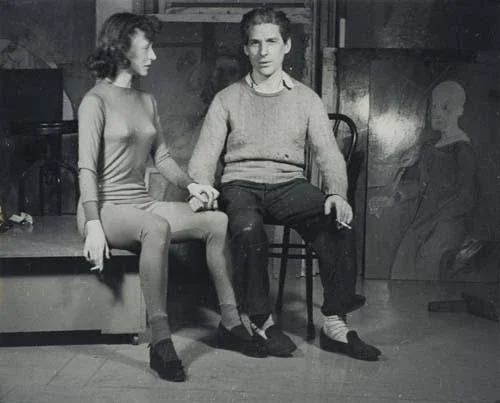
Willem and Elaine de Kooning, New York, 1940s, silver print, by Ellen Auerbach [4]
In 1934, Francis Bacon completed a semi-abstract pen and ink drawing called Corner of the Studio. In the high-key background, a door and a textured wall are visible, while the middle and foreground contain mysterious biomorphic forms lit in sharp contrast. It was during a party hosted by Bacon, that Lucien Freud stood in Bacon’s actual studio and saw Painting, 1946. According to author and art critic, Sebastian Smee, even fifty years on, through the ups and downs of their complex relationship, Lucian never got over Painting, 1946, “that marvelous one”. [5] Bacon’s art studio is well-documented; in photographs it can easily be described as dangerously messy and chaotic. But to my eyes, this is creative impetus and initiative. John Baldessari said it best, “Talent is cheap, you have to be possessed or obsessed, rather. You really have to feel like you cannot not do art, and that is something you can't will.” [6]
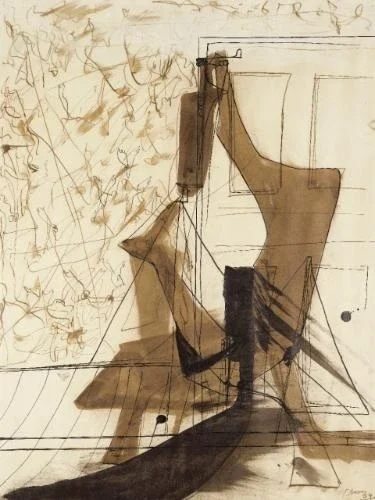
Corner of the Studio, Bacon, pen and ink on paper, 1934 [7]
In the fall of 1889, Vincent van Gogh was hospitalized in Saint-Rémy when he painted Window in the Studio. Despite the bars on the hospital window, this scene is sanctified by van Gogh’s yellow and the cool light from the window. This corner of his studio depicts more of his work flanking both sides of the window, as well as his utensils, bottles and boxes.
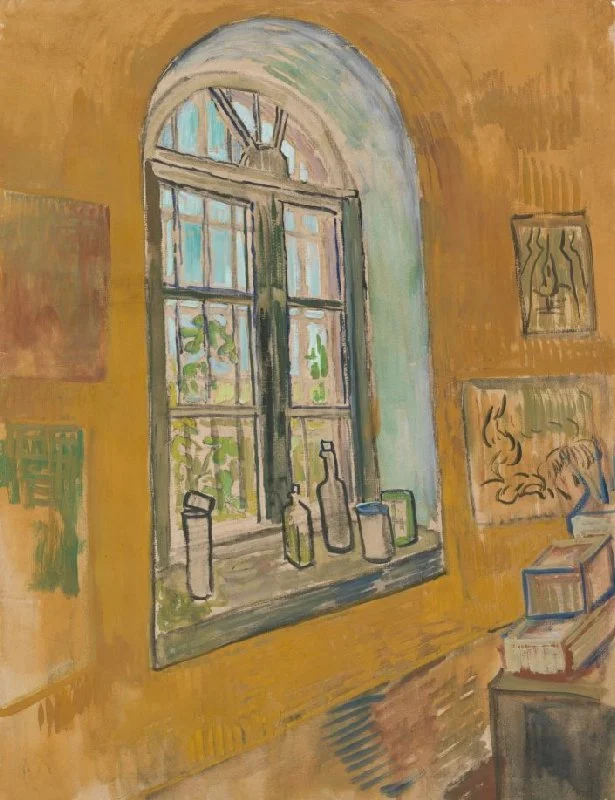
Window in the Studio, Vincent van Gogh, chalk, brush and oil paint and watercolor, on paper, 1889 [8]
Working as court painter for the Spanish Royals, Diego Velazquez created Las Meninas in 1656. While the maids in waiting and dog are bathed in elegant light and take up the vital foreground, mathematically speaking, it is the artist’s space that makes up the other two thirds of the composition, including additional paintings on the walls. The artist, his painting, and his active work (making the painting) are featured on the left side spanning the entire top and bottom.
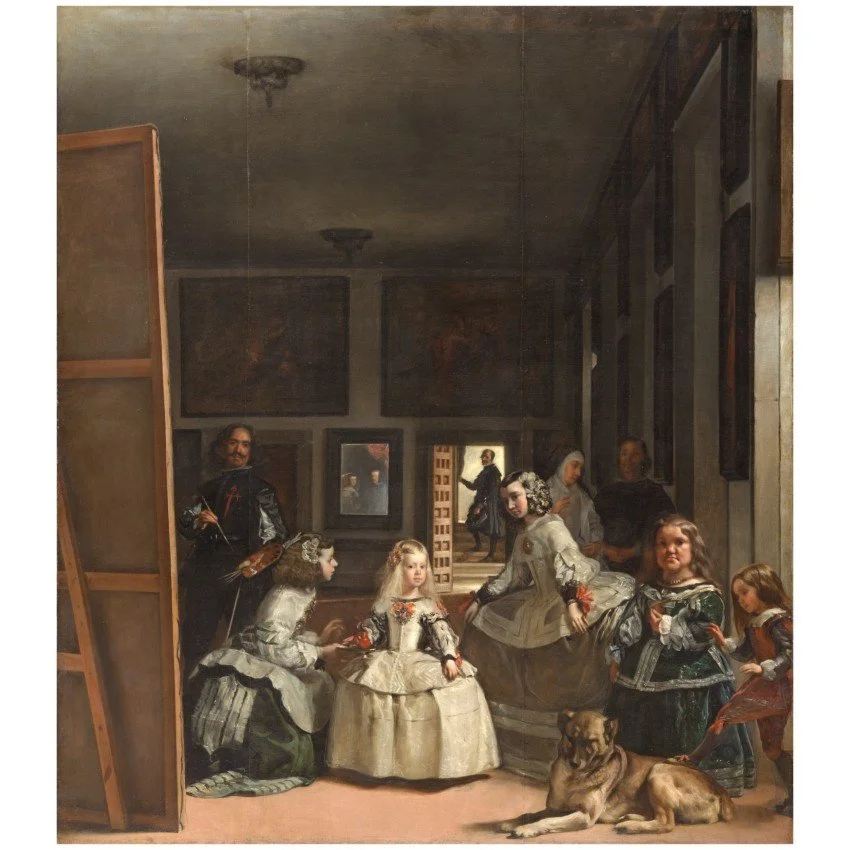
Las Meninas, Diego Velazquez, oil, 1656 [9]
Henri Matisse gave us The Red Studio in 1911. The nearly square composition is saturated in vibrant Venetian red, accented by bubblegum pinks and delicate golden lines that fade to white in places. The depicted space is imbued with the artist’s creative essence in the form of the color red. Matisse’s studio is also well-documented, it was white and well-lit.
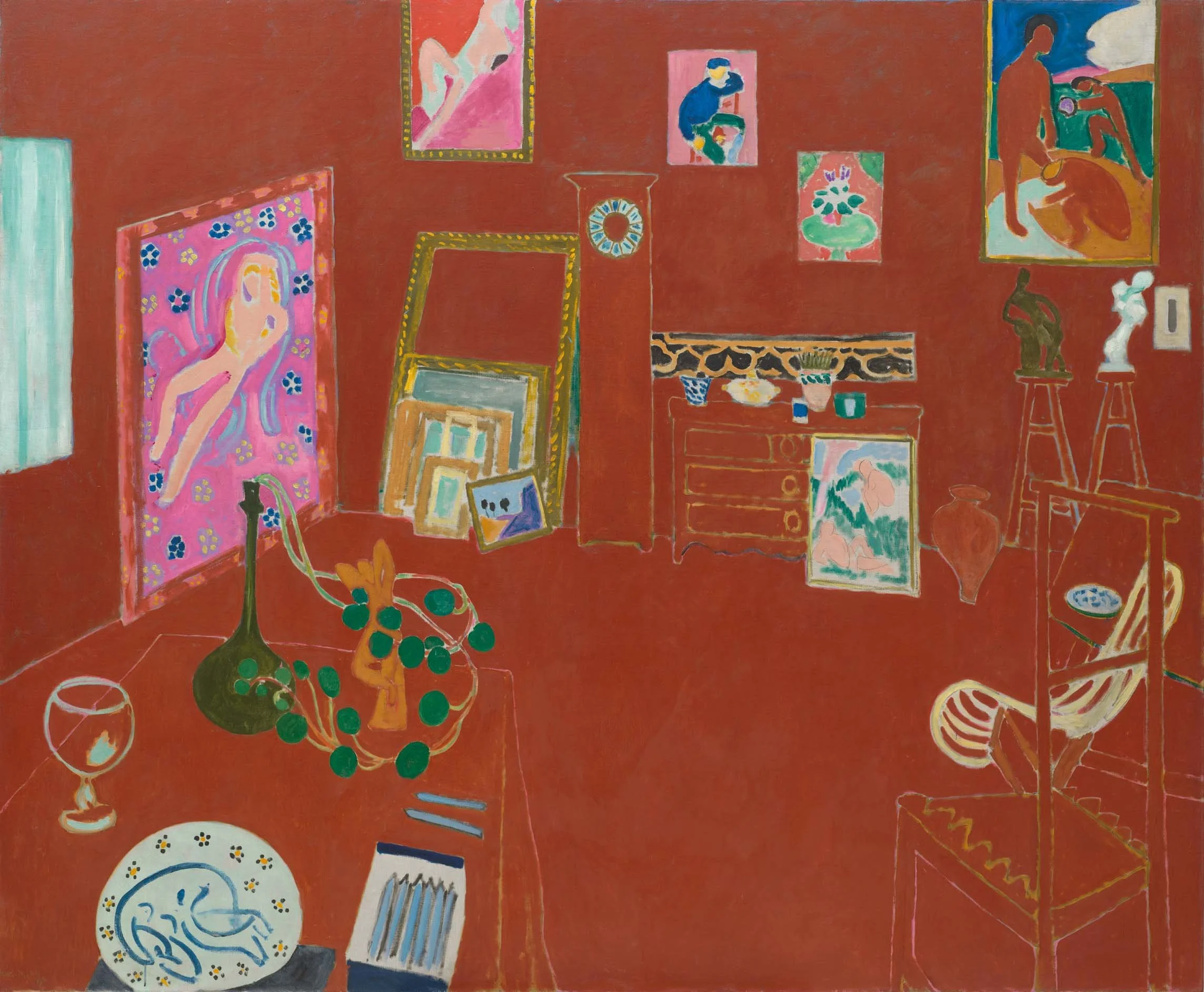
The Red Studio, Henri Matisse, oil, 1911 [10]
While the celebrated works displayed in galleries, museums, or private collections bear clear ties to history and its systems, they once existed solely within the artist’s heart, mind, and soul. Their heartbeats and breaths are inscribed in every gesture. The same holds true for work that is never shared. The cliché of dancing as though no one is watching remains an invaluable metaphor for the self-determination required to create something original and truthful. Curate creative space.
For your exploration, here are three sites which have curated thoughts about and images of artists’ spaces:
Sources:
1. Vonnegut Jr., Kurt. A Man Without a Country. Seven Stories Press. 2005.
2. etymonline. online etymology dictionary, https://www.etymonline.com/
3. Gabriel, Mary. Ninth Street Women: Lee Krasner, Elaine de Kooning, Grace Hartigan, Joan Mitchell, and Helen Frankenthaler: Five Painters and the Movement That Changed Modern Art. Back Bay Books. Little, Brown and Company. 2018.
4. Willem and Elaine de Kooning, New York, 1940s, by Ellen Auerbach. Mutual Art, https://www.mutualart.com/
5. Smee, Sebastian. The Art of Rivalry: Four Friendships, Betrayals, and Breakthroughs in Modern Art. Random House. 2016.
6. A Brief History of John Baldessari. Directed by Henry Joost and Ariel Schulman. Narrated by Tom Waits. Commissioned by LACMA. 2012.
7. Bacon, Francis. Corner of the Studio.1934. The Estate of Francis Bacon. Mutual Art, https://www.mutualart.com/
8. van Gogh, Vincent. Window in the Studio. 1889. Van Gogh Museum, Amsterdam (Vincent van Gogh Foundation), https://www.vangoghmuseum.nl
9. Velazquez, Diego. Las Meninas. 1656. Museo del Prado, https://www.museodelprado.es
10. Matisse, Henri. The Red Studio. 1911. The National Gallery of Denmark, https://www.smk.dk/